If you have ever sat down to plan a Google Ads budget, you already know the frustrating part: there is no set price. Ask ten business owners what they spend and you will get ten different answers, from a few hundred dollars a month to well into six figures. That is not because anyone is guessing. It is because your cost depends on your industry, your competition, the keywords you go after, and how well your account is managed.
The honest answer to “how much do Google Ads cost?” is that it depends. However, this is not a useful answer when you are trying to build a marketing budget. This guide gives you real numbers to work with, explains what moves your costs up or down, and shows you how to decide what your business should budget in 2026.
Key Takeaways
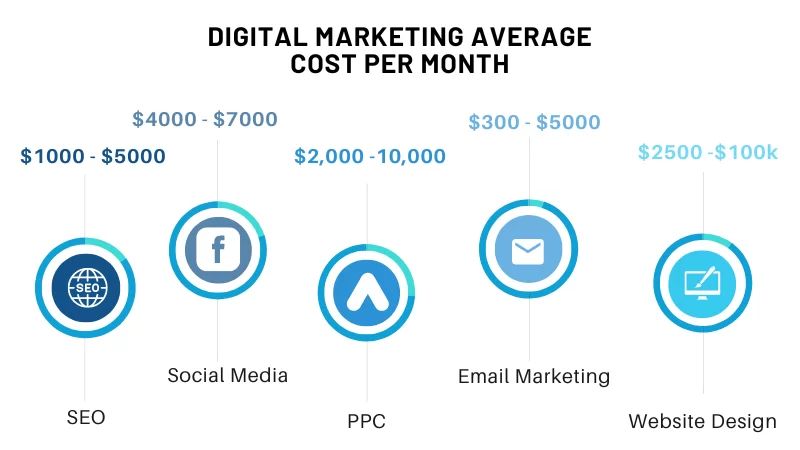
- There is no fixed price for Google Ads. You set the budget, and you pay only when someone clicks your ad. Most businesses spend somewhere between $1,000 and $10,000 per month, with an average cost-per-click (CPC) of roughly $1 to $5 depending on the industry.
- Your industry is the single biggest factor in what you pay. Competitive fields like legal and insurance can see average clicks north of $65, while sectors like fitness and real estate often stay closer to $5.
- Quality Score can cut your costs in half. Google rewards relevant ads and strong landing pages. Two advertisers bidding the same amount can pay very different prices depending on their Quality Scores.
- A useful starting framework is 70-20-10. Put about 70% of your budget toward proven, automated core campaigns, 20% toward testing new keywords and audiences, and 10% toward experiments.
- Rising costs do not mean poor returns. In a WebFX survey of over 350 businesses, 54% reported satisfaction with their PPC return on investment, and more advertisers planned to increase their spending than cut it.
How Much Do Google Ads Actually Cost?
Google Ads runs on an auction. You choose how much you are willing to pay, Google factors in the quality of your ad, and you pay only when someone clicks. That means you are never locked into a set fee, and you can start small and scale as you see results.
For a general benchmark, most businesses spend between $1,000 and $10,000 per month on their campaigns, and the average cost-per-click lands somewhere around $1 to $5. Lower-competition sectors like retail and entertainment tend to sit at the bottom of that range. Higher-competition sectors like legal, finance, and insurance sit well above it.
The takeaway for budgeting is simple. Your CPC times your expected number of clicks gives you a rough monthly spend. If your keywords average $4 per click and you want 1,000 clicks a month, you are looking at about $4,000 in ad spend before management costs. Knowing your numbers is what turns a vague “it depends” into a plan.
Average Google Ads CPC by Industry
Your industry does more to shape your budget than almost anything else. High-value industries can afford to bid aggressively because a single new customer might be worth thousands of dollars, which pushes the going rate for a click way up. A personal injury attorney can justify paying $50 or more for one click when a single case could be worth tens of thousands. A boutique fitness studio simply cannot, because each customer is worth far less.
Here is a breakdown of average CPC by industry
| Industry | Average CPC |
|---|---|
| Legal | $71.64 |
| Insurance | $67.73 |
| Home Services | $40.87 |
| Marketing/Digital | $33.92 |
| Software/SaaS | $23.63 |
| Finance | $22.59 |
| Professional Services | $17.58 |
| Medical/Dental | $5.51 |
| Real Estate | $5.38 |
| Fitness/Health | $5.03 |
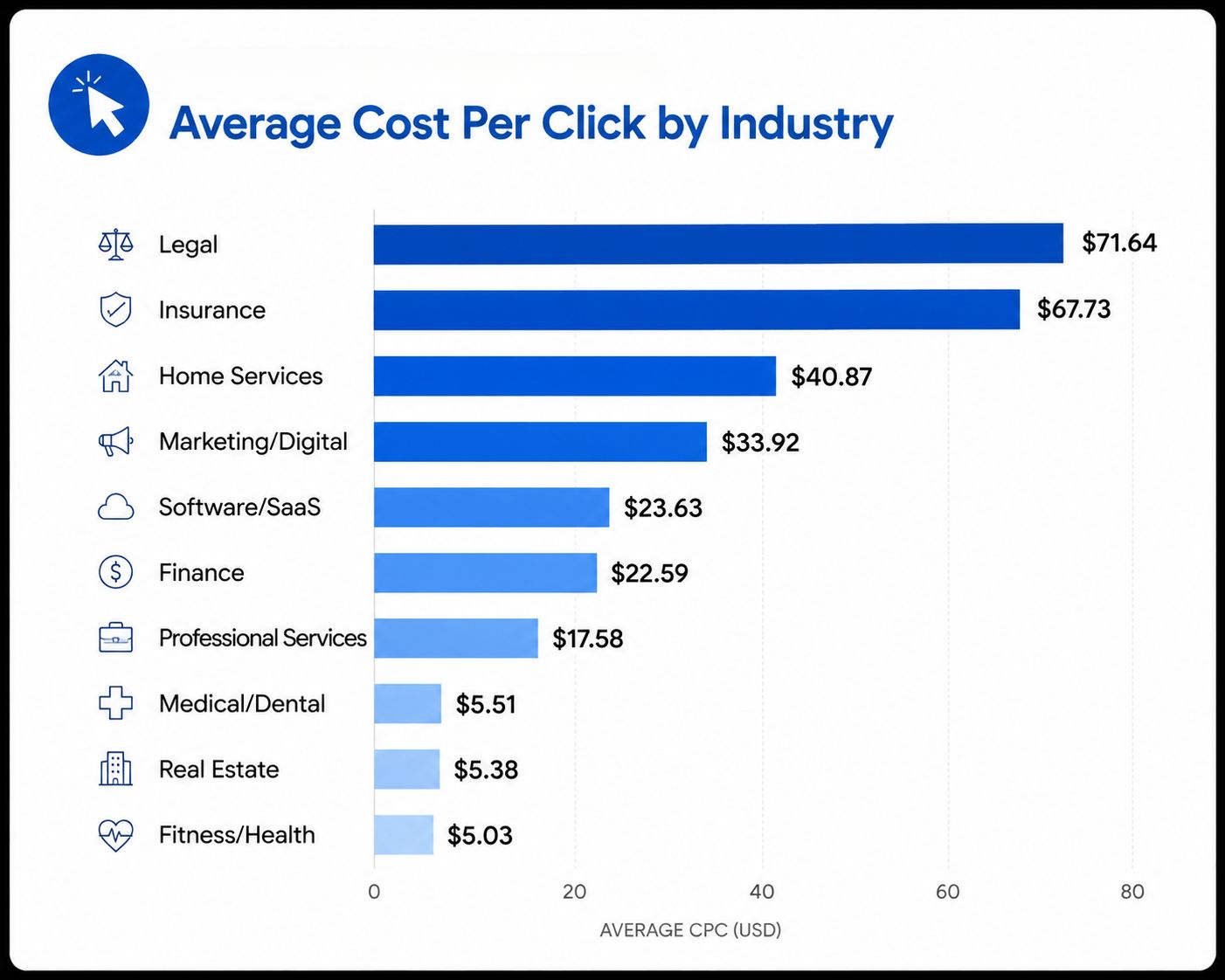
Treat these as reference points, not fixed rates. Your actual CPC will shift based on your city, how many competitors are bidding on the same terms, and the specific keywords you target. Still, seeing that legal clicks can cost more than ten times a real estate click tells you a lot about what kind of budget your industry demands.
What Drives Your Google Ads Costs in 2026
Beyond your industry, a handful of factors decide whether you get more or less out of every dollar.
Competition Level
The more advertisers bidding on the same keywords, the higher the price of the auction. When everyone in your market wants “emergency plumber near me,” the cost of that click climbs for everyone. This is why smart advertisers look for less crowded, more specific terms where they can win at a lower price.
Quality Score
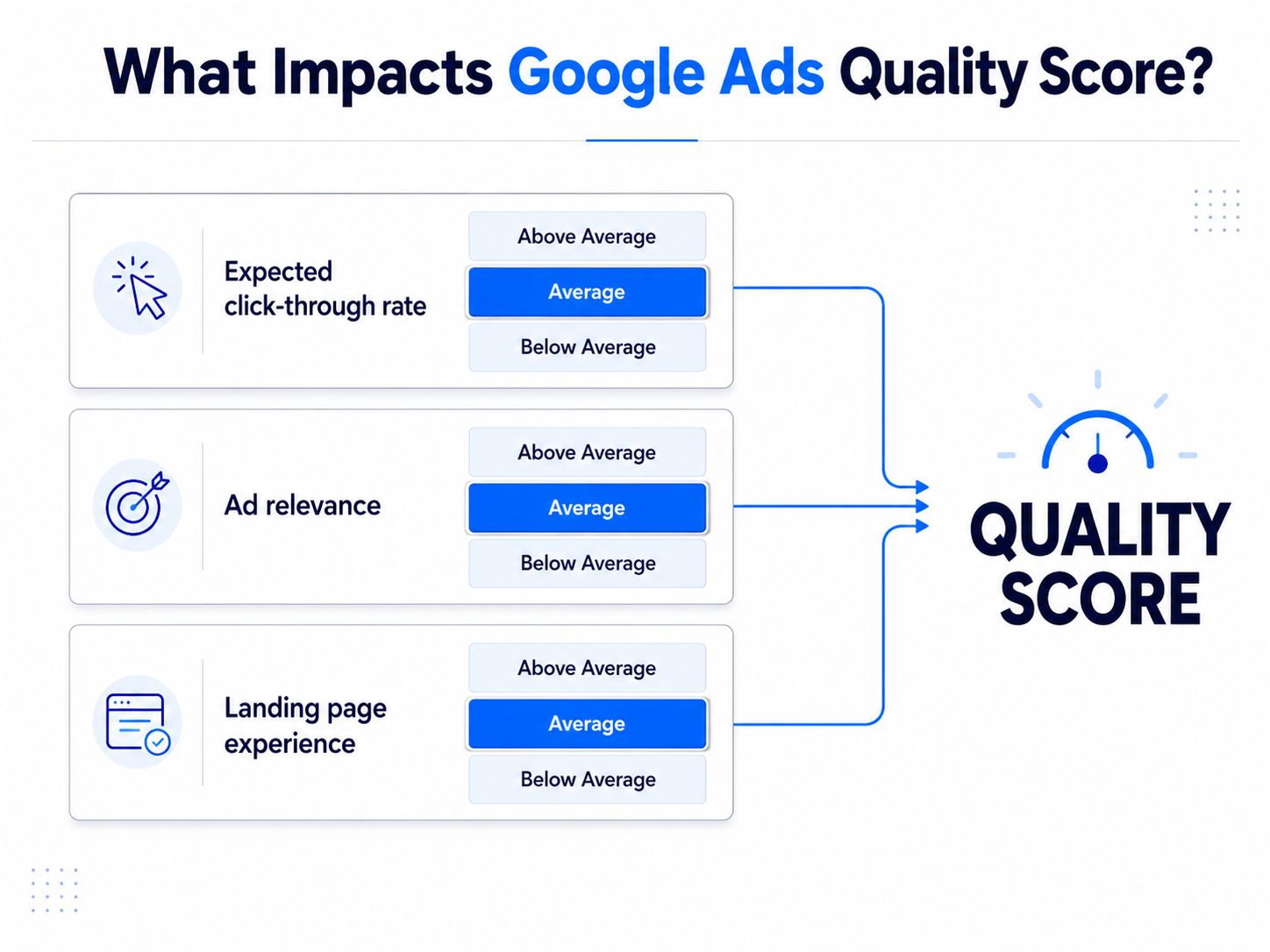
This is the factor most business owners overlook, and it is one of the most important. Quality Score is Google’s 1-to-10 rating of your ad, based on how likely people are to click it, how closely it matches what they searched for, and how good the landing page is once they arrive. A high Quality Score can lower what you pay per click by a wide margin. If your score is a 10 and a competitor’s is a 5, you could pay far less than they do for the same position. In other words, better ads and better landing pages are not just nice to have. They directly lower your costs.
Campaign Type
Where and how your ads run affects the price. Search ads cost more per click but reach people who are actively looking for what you sell, usually in that $2 to $5 range. Display ads reach people who are browsing rather than buying and often cost under $1. Shopping campaigns sit in between and work well for online stores, while video and Performance Max campaigns use automation to spread your budget across Google’s channels. If you are not sure which format fits your goals, see our guide on how to choose the right Google Ads campaign type.
The Keywords You Target
Broad, high-demand terms like “car insurance” attract a crowd and cost a premium. Longer, more specific phrases like “affordable car insurance for college students” usually cost less, face less competition, and often convert better because the person searching knows exactly what they want. Match type matters too. Broad match casts a wide net but can trigger your ad for loosely related searches, while exact match gives you tighter control over who sees it.
How Well the Account Is Managed
A neglected account quietly bleeds money on irrelevant clicks and underperforming keywords. A well-managed one gets steadily cheaper and more effective because someone is reviewing search terms, adding negative keywords, pausing what is not working, and testing new ad copy. Google also rewards active, well-structured accounts with better placement at lower cost. This is why working with an experienced PPC management team pays for itself.
How Much Should Your Business Budget on Google Ads?
Once you understand what drives your costs, the next question is how to split up your budget. A framework that works well in 2026, updated for the way automation now handles campaigns, is the 70-20-10 rule:
- 70% to your proven core: Put the bulk of your budget behind campaigns and keywords that already convert and let Google’s Smart Bidding and Performance Max tools optimize them.
- 20% to testing: Use a fifth of your budget to explore new keywords, new audiences, and opportunities the platform suggests.
- 10% to experiments: Reserve a small slice for newer ad formats and bigger swings that could pay off down the road, the same instinct behind early movers testing channels like ChatGPT advertising.
As for how much of your overall marketing budget should go to PPC, most businesses land in a healthy middle. Advertisers who report the strongest returns tended to put roughly 15% to 35% of their marketing budget into paid search. That is enough to make a real difference without leaning on ads so heavily that one auction shift throws off your whole plan. For a closer look at how PPC stacks up against organic channels when you are deciding where those dollars go, see our comparison of PPC vs. SEO ranking methods and KPIs.
If you are just getting started, there is nothing wrong with beginning smaller to gather data, then scaling up once you can see which campaigns generate leads.
Google Ads Spend Terms to Know
Setting a budget is easier once you’re comfortable with the metrics Google Ads uses to report on it. A few terms come up constantly when you’re planning or reviewing spend:
- Cost per click (CPC) is simply the average price you pay each time someone clicks your ad. It’s the number most businesses start with when estimating a budget, since multiplying your target CPC by your desired click volume gives you a rough monthly figure.
- Cost per lead (CPL), sometimes labeled cost per acquisition (CPA) or shown as “cost/conv.” inside the platform, tells you what each conversion actually cost you. This is usually the more meaningful number for service businesses, since two campaigns with very different CPCs can end up costing the same per lead depending on how well they convert.
- Cost per thousand impressions (CPM) matters mainly for Display and Video campaigns, where the goal is visibility rather than immediate clicks. It measures what you’re paying for every thousand times your ad is shown, regardless of whether anyone clicks.
- Return on ad spend (ROAS) compares what you spent against the revenue those ads generated. It’s the metric ecommerce businesses lean on most, and it only works accurately once you’ve assigned dollar values to your conversion actions in Google Ads.
- Conversion value is closely related to ROAS: it’s the average dollar amount a single conversion is worth to your business. Assigning conversion values lets you tell the difference between a lead who bought a $50 item and one who bought a $500 item, rather than treating every conversion as equally valuable.
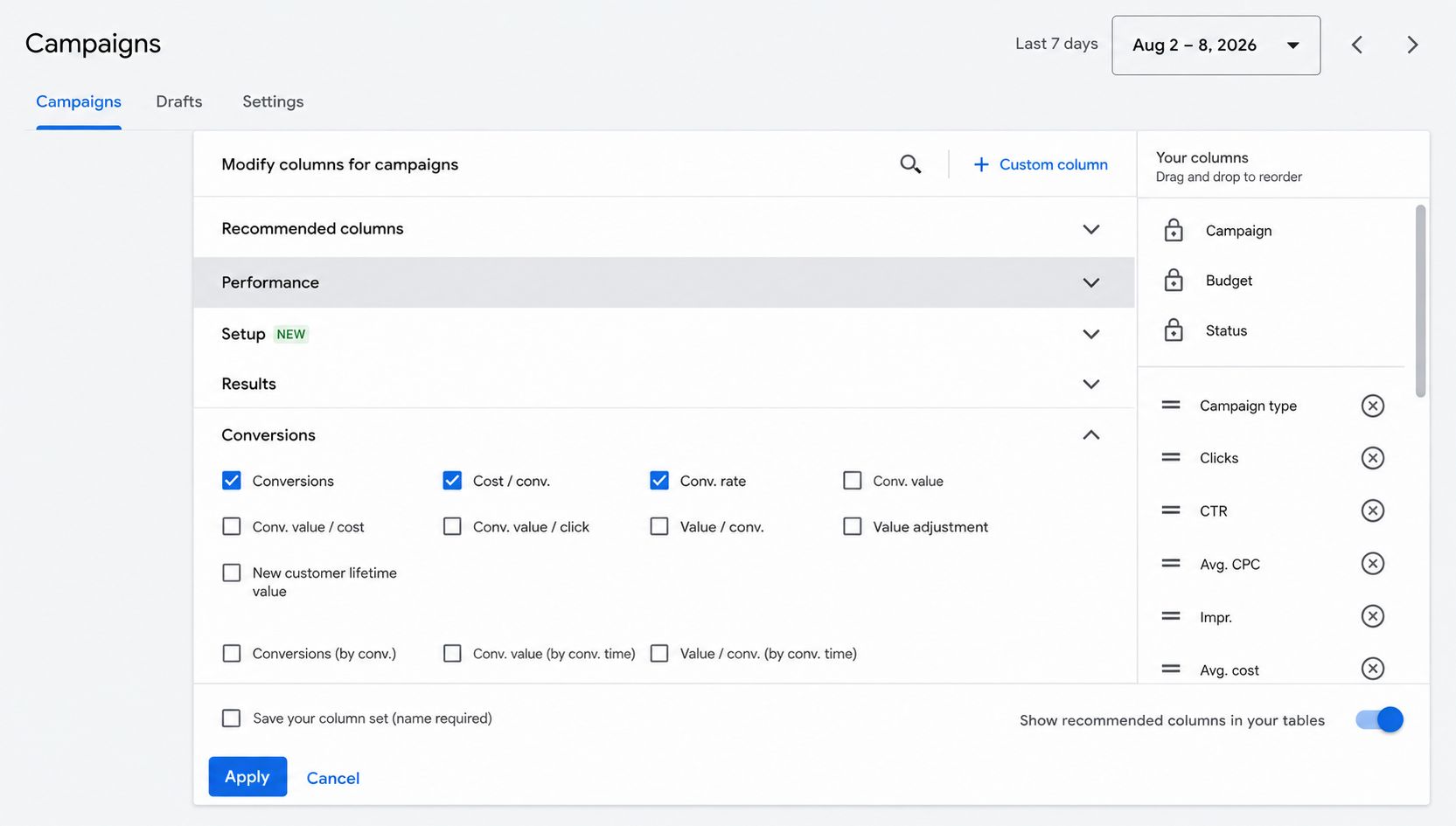
Google Ads offers several other spend metrics you can add to your reporting columns, but CPC, CPL, CPM, ROAS, and conversion value are the ones that matter most for deciding how your budget is actually performing.
Getting More from Every Dollar
Rising click prices are real, but so is the opportunity to spend smarter. A few habits separate accounts that waste money from accounts that grow:
Lean on automation where it helps. Performance Max and Smart Bidding can adjust bids in real time based on patterns a human could never track manually. Build out your negative keyword lists so you stop paying for searches that will never turn into customers. Watch your geography, since the cost of the same click can vary dramatically from one city to the next, and there is often room to prioritize lower-cost markets first. And keep your landing pages sharp, because a faster, more relevant page lifts your Quality Score and lowers your cost at the same time.
None of this is glamorous. It is steady, ongoing work. But it is the difference between an account that gets more expensive every quarter and one that gets more efficient.
Is Google Ads Worth It in 2026?
With costs climbing in competitive industries, it is fair to ask whether paid search still earns its keep. The data says yes, for businesses that manage it well, as 54% of businesses reported being satisfied with their PPC return on investment, 26% planned to increase their spending over the next six months, and only 13% planned to cut back. When more advertisers are adding budget than pulling it, that tells you the channel is still working for the people who understand it.
The real lesson is that success comes from knowing your own numbers. When you know a new customer is worth $5,000 over the next few years, a $50 click stops looking expensive and starts looking like a smart trade. The businesses that struggle are usually the ones spending without tracking what comes back. The ones that win treat Google Ads less like a bill and more like an investment they measure and refine.
Frequently Asked Questions About Google Ads Costs
How much do Google Ads cost per month?
Most businesses spend between $1,000 and $10,000 per month, and the required minimum is $1,000. You control your daily and monthly budget, and you can start with $1,000 and increase spending as you see which campaigns produce leads.
What is the average cost-per-click for Google Ads?
The average CPC across industries is roughly $1 to $5, but it varies widely. Competitive fields like legal services and insurance can see average clicks well above $65, while less competitive fields like fitness and real estate often stay near $5.
Why is my industry so expensive to advertise in?
High-value industries pay more per click because a single customer is worth more. When one new client can generate thousands of dollars in revenue, advertisers can afford to bid aggressively, which raises the price of every click in that market. More competitors bidding on the same keywords also drives costs up.
What is Quality Score and why does it matter?
Quality Score is Google’s 1-to-10 rating of your ad’s quality, based on expected click-through rate, ad relevance, and landing page experience. A higher score can lower your cost per click significantly, sometimes by as much as half compared with an advertiser who has a lower score bidding the same amount.
How should I divide my Google Ads budget?
A practical starting point is the 70-20-10 rule: about 70% toward proven core campaigns, 20% toward testing new keywords and audiences, and 10% toward experiments. Most businesses with strong returns put roughly 15% to 35% of their total marketing budget into paid search.
Is Google Ads still worth it in 2026?
For businesses that track results and manage their accounts well, yes. Survey data shows a majority of advertisers are satisfied with their returns, and more plan to increase spending than decrease it. The key is knowing what a customer is worth to you and optimizing toward real business outcomes rather than surface metrics.
Do I need an agency to run Google Ads?
You can run campaigns yourself, but a well-managed account almost always outperforms a neglected one. An experienced team continuously refines bids, keywords, and landing pages to lower your costs and improve results, which often more than covers the cost of management. If your time is better spent running your business, partnering with a PPC agency is usually worth it.
Let Proceed Innovative Manage Your Google Ads
Understanding the numbers is the first step. Turning them into campaigns that consistently generate leads is where a partner makes the difference. At Proceed Innovative, our Chicago-based team of Google Ads specialists builds data-driven pay-per-click campaigns designed around a strong return on ad spend, not just clicks. We handle keyword research, ad copy, landing pages, bid management, and ongoing optimization so every dollar of your budget works harder.
Whether you are a local service business or a national brand, we tailor your strategy to your industry, your goals, and your competition. As a certified search agency with experience managing six- and seven-figure monthly budgets, we know how to keep your costs efficient while your results grow, which is what makes our Google Ads services different from a generic ad account setup.
Ready to make your Google Ads budget work harder? Explore our PPC management services or call us at (800) 933-2402 for a free PPC audit. Let’s build a paid search strategy that turns your ad spend into real, measurable growth.
About the Author: Yashasvi Rochwani