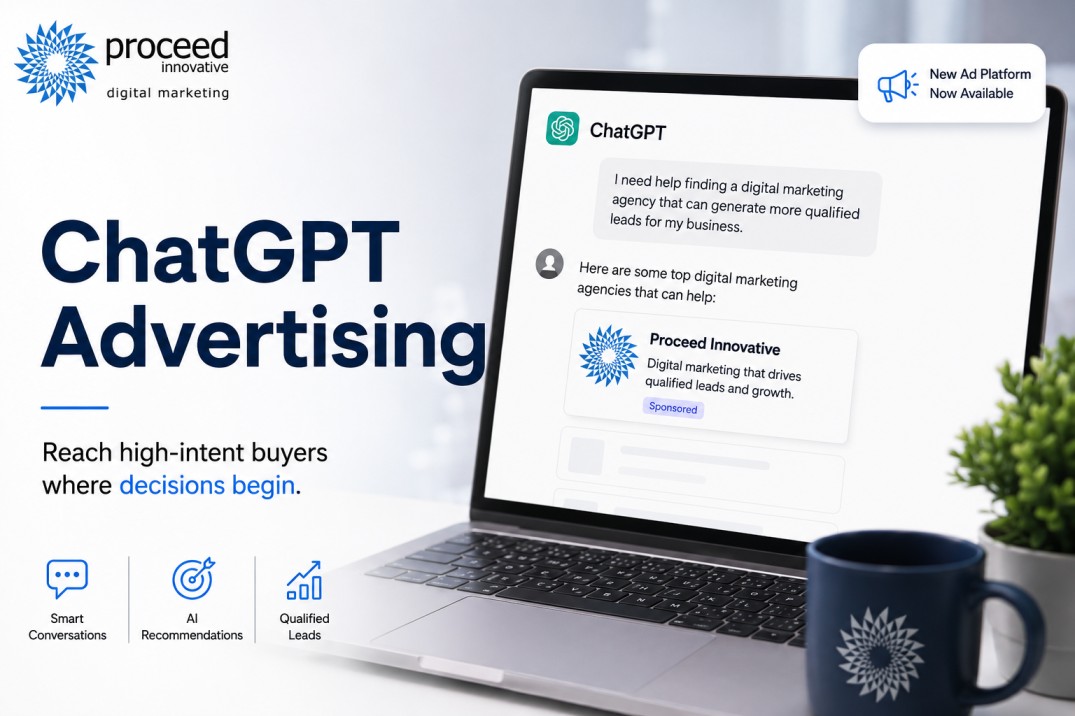
For the past two years, businesses have been asking the same questions about artificial intelligence.
Is AI really changing marketing?
Will customers actually use ChatGPT instead of Google?
Do we need to pay attention to this now, or can it wait?
Those questions just got answered.
OpenAI has officially launched its advertising platform and opened access to businesses across the United States. What was once limited to large brands with massive budgets is now available to businesses of all sizes.
This is not a beta test.
This is not an experiment.
This is the beginning of a new advertising channel where customers are actively researching products, evaluating solutions, asking questions, and making buying decisions.
And just like the early days of Google Ads and Facebook Advertising, the businesses that move first will gain an advantage that becomes increasingly difficult for competitors to overcome.
Why This Matters More Than Most Businesses Realize
Many business owners hear “ChatGPT advertising” and immediately assume it’s simply another version of Google Ads.
It isn’t.
Google search is built around keywords.
ChatGPT is built around conversations.
When someone searches Google, they often type a few words and click through a list of websites.
When someone uses ChatGPT, they explain their situation, provide context, ask follow-up questions, compare options, and refine their search until they find the best solution.
Instead of searching:
“best marketing agency”
A user may ask:
“I’m a manufacturing company in Illinois with a small marketing team. We need help generating more qualified leads and improving our visibility online. What are our best options?”
The difference is enormous.
AI platforms understand context, goals, pain points, budgets, industries, and user intent in ways traditional search engines never could.
That changes how businesses will market themselves online.

OpenAI Is Building a Massive Advertising Platform
The scale of what OpenAI is building cannot be ignored.
ChatGPT has become one of the fastest-growing technology platforms in history, with billions of prompts submitted every day.
Users are not simply browsing.
They are researching.
They are evaluating solutions.
They are looking for recommendations.
They are making purchasing decisions.
OpenAI’s long-term revenue projections indicate that advertising will become one of the company’s primary growth engines, positioning ChatGPT as a major player in the future of digital advertising.
This is not a side project.
It is a strategic investment in becoming one of the largest advertising platforms in the world.
Why Local Businesses and B2B Companies Should Pay Attention
Many business owners assume AI advertising is only relevant for major consumer brands.
That assumption could become a costly mistake.
Local service providers, healthcare organizations, manufacturers, professional services firms, contractors, technology companies, and B2B businesses may benefit significantly from AI-driven search and advertising.
When users ask AI assistants for recommendations, vendors, agencies, service providers, consultants, or local businesses, the platforms generate responses based on available information and authority signals.
That means visibility inside AI systems is becoming just as important as visibility inside traditional search engines.
Businesses that establish authority today are positioning themselves to benefit from both organic AI recommendations and paid AI advertising opportunities.
The Rise of AI Visibility and Answer Engine Optimization
The launch of ChatGPT advertising highlights a larger trend that many businesses have not fully recognized.
Search is changing.
Consumers are increasingly receiving direct answers instead of lists of links.
Platforms such as ChatGPT, Perplexity, Google AI Overviews, Gemini, and other AI-powered search experiences are changing how people discover businesses online.
This shift has created an entirely new discipline known as Answer Engine Optimization (AEO).
AEO focuses on helping businesses become trusted sources that AI systems reference when generating answers.
While traditional SEO remains essential, businesses must now think beyond rankings and focus on becoming visible wherever AI-generated recommendations are being delivered.
The businesses that invest in AI visibility today will have a significant advantage as consumer behavior continues to evolve.
Why AI-Referred Traffic Could Be More Valuable
One of the most interesting developments surrounding AI search is the quality of traffic it generates.
Think about the difference between a random website visitor and someone who arrives after receiving a recommendation from an AI assistant.
The AI user has already:
- Identified a problem
- Researched potential solutions
- Evaluated options
- Received a recommendation
- Decided to learn more
That visitor is often much further along in the buying journey.
Instead of attracting cold traffic, businesses have the opportunity to engage users who already understand their needs and are actively evaluating solutions.
For businesses focused on lead generation, this could significantly improve conversion rates and overall marketing efficiency.
What This Means for Your Existing Marketing Strategy
One of the most common questions business owners ask is whether AI advertising will replace SEO, Google Ads, or other marketing channels.
The answer is no.
However, it will change how these channels work together.
Businesses should expect increasing overlap between:
- Search Engine Optimization (SEO)
- Answer Engine Optimization (AEO)
- Google Ads
- ChatGPT Advertising
- Content Marketing
- Local SEO
- Conversion Rate Optimization
The content that helps your business rank in search engines may also help AI systems recommend your business.
The landing pages that convert Google Ads visitors may also be responsible for converting AI-referred traffic.
The companies that build integrated marketing strategies will be positioned to outperform competitors that continue treating every channel separately.
Five Things Every Business Should Do Right Now
1. Evaluate Your AI Visibility
Open ChatGPT and ask the same questions your customers ask.
- Search for your services.
- Search for your industry.
- Search for your competitors.
- Does your business appear?
- Do competitors appear?
- What information is being presented?
Understanding your current visibility is the first step toward improving it.
2. Audit Your Website Experience
If AI platforms begin sending visitors to your website, what happens next?
Can visitors quickly understand what you do?
Can they find the information they need?
Can they easily contact you?
Your website remains one of the most important conversion tools in your marketing strategy.
3. Create Helpful, Expert-Level Content
Businesses that consistently publish useful, authoritative content are more likely to be cited by both search engines and AI systems.
Focus on answering the questions your customers ask every day.
The more expertise you demonstrate, the stronger your visibility becomes.
4. Strengthen Local SEO Signals
Local visibility remains essential.
Ensure your business information is accurate and consistent across directories, maps, review platforms, and your website.
Strong local SEO helps improve visibility in both traditional search and AI-generated recommendations.
5. Develop an AI Marketing Strategy
Businesses should begin evaluating how AI search, AI advertising, SEO, content marketing, and lead generation fit together.
The organizations that create a plan today will have a significant advantage over businesses that wait until competition increases.
ChatGPT Advertising Requires More Than Ad Spend
Launching ads is only one piece of the puzzle.
Successful AI marketing campaigns require:
- Strong SEO foundations
- High-quality content
- Clear service positioning
- Fast, user-friendly websites
- Positive reviews
- Consistent brand authority
- Effective landing pages
Without these elements, businesses may struggle to convert the traffic they generate.
The companies that combine AI advertising with strong organic visibility will likely achieve the best long-term results.
The Early-Mover Advantage Is Real
Every major advertising platform follows a similar pattern.
First comes adoption by innovators.
Then early competition.
Then widespread adoption.
Finally, rising costs and increased competition.
Businesses that embraced Google Ads in the early 2000s gained years of competitive advantage.
The same happened with Facebook advertising, LinkedIn advertising, and mobile marketing.
AI advertising appears to be following a similar path.
The businesses learning today will have more data, more experience, and better optimization capabilities tomorrow.
The Future of Marketing Is Already Here
Artificial intelligence is no longer a future trend.
It is actively changing how customers research products, discover businesses, and make purchasing decisions.
Whether your organization serves local customers, regional markets, or national audiences, AI visibility will increasingly influence your ability to generate leads and grow revenue.
The businesses that prepare now will be positioned to benefit from this shift.
The businesses that wait may find themselves competing against organizations that have already established authority and visibility inside the platforms customers use every day.
How Proceed Innovative Helps Businesses Succeed in the AI Era
At Proceed Innovative, we help businesses prepare for the future of search and digital marketing through:
- AI Visibility Audits
- Answer Engine Optimization (AEO)
- Search Engine Optimization (SEO)
- Local SEO
- Content Strategy
- ChatGPT Advertising Support
- Conversion Optimization
- Integrated Digital Marketing Strategies
Our team helps businesses understand where they currently stand, identify growth opportunities, and develop strategies that improve visibility across both traditional search engines and emerging AI platforms.
If you’re interested in learning how AI search, ChatGPT advertising, and Answer Engine Optimization can impact your business, contact Proceed Innovative to schedule a consultation.
About the Author: Jasmine Panayotov