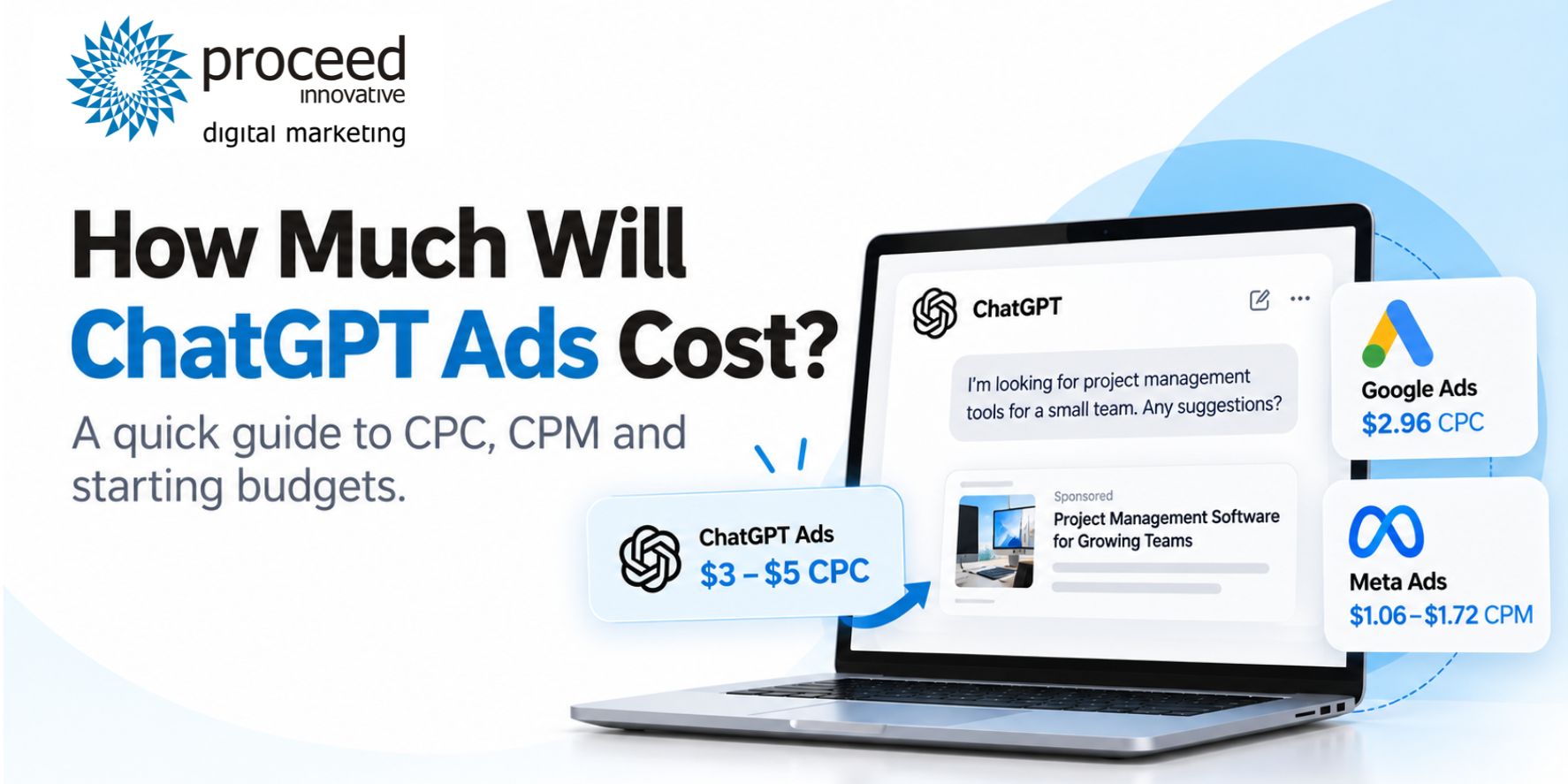
ChatGPT Ads don’t have a fixed price. In 2026, businesses can advertise on ChatGPT using CPC (cost per click) or CPM (cost per 1,000 impressions) pricing, with actual costs determined through an advertising auction. For click-based campaigns, OpenAI recommends starting with a maximum bid of $3 to $5 per click, while the standard minimum daily campaign budget in the U.S. is $25.
However, the amount you bid is only part of the equation. What you spend, how many potential customers you reach, and whether those visitors become leads depend on your competition, ad relevance, campaign settings, and landing page experience.
For businesses already investing in Google Ads, Microsoft Ads, or Meta Ads, ChatGPT introduces another way to connect with customers during their research and decision-making process. Unlike traditional search advertising, which relies heavily on keyword-based searches, ChatGPT Ads can match advertisements to the context of a conversation.
So, how much should you actually budget, and is ChatGPT advertising worth the investment? Let’s look at the pricing models, estimated costs, and what businesses should consider before launching a campaign.
ChatGPT Ads Pricing: Key Takeaways
- ChatGPT Ads currently support CPC and CPM buying.
- OpenAI recommends starting CPC bids around $3 to $5.
- Actual prices are set by a relevance-weighted, second-price auction.
- There’s no single universal ChatGPT Ads cost.
- Your campaign objective determines how you’re billed.
- Advertisers can set daily or campaign total budgets, with a $25 daily minimum in the U.S.
- Conversion tracking is available through Ads Manager.
- Performance should be judged on business outcomes, not clicks alone.
Not Sure How Much to Budget for ChatGPT Ads?
Every business has different goals, competition, and sales cycles, so the right starting budget isn’t the same for everyone. Our team can review your situation, estimate what your clicks and leads might cost, and recommend a test budget that makes sense for your business.
Request a Free ChatGPT Ads Consultation
How Much Does It Cost to Advertise on ChatGPT?
ChatGPT Ads cost whatever the auction says they cost, within limits you set. You choose a pricing model, set a maximum bid and a budget, and OpenAI’s system decides when your ad shows and what you pay. Here’s how the current options break down:
| Pricing model | How you pay | Current information |
|---|---|---|
| CPC | Per valid click | OpenAI recommends a $3–$5 maximum CPC to start |
| CPM | Per 1,000 impressions | Available for Views (impression-based) campaigns |
| Conversion optimized | CPC or CPM, depending on eligibility | Optimizes toward a supported conversion event |
One point that trips up a lot of advertisers is that $3 to $5 is a recommended starting maximum bid. It isn’t a fixed rate, and it isn’t a guaranteed price. OpenAI uses a relevance-weighted, second-price auction, so many clicks clear below your maximum bid (OpenAI Help Center).
What Is the Average Cost Per Click (CPC) for ChatGPT Ads?
There isn’t a reliable industry-wide average CPC for ChatGPT Ads yet. The platform is too new, and OpenAI publishes a recommended bid rather than a clearing price. Here’s what we do know:
- OpenAI recommends a $3–$5 maximum CPC as a starting bid.
- Your actual CPC can be lower or higher than that.
- Prices are set by auction, so cost shifts with the number of advertisers competing in your category.
- Advertisers compete on eligibility, relevance and other delivery factors, not bid alone.
Early third-party reports show how wide the spread can be. Context Hints cites one publicly documented account that averaged about $1.72 per click over 15 days, and separate reports of B2B categories running $8 to $15 per click. Those are individual data points, not benchmarks.
So be wary of any page that gives you a single “average ChatGPT CPC.” For now, the honest number is OpenAI’s recommended starting range, plus whatever your own account data shows once you’re live.
How Does ChatGPT Ads Pricing Work?
ChatGPT Ads pricing depends on the campaign objective you choose and how your bid performs in the ad auction. OpenAI currently offers three campaign objectives: Views, Clicks, and Conversions. Each objective determines what you’re optimizing for and how you’re charged, so choosing the right one is an important part of managing your ad budget.
Cost Per Click (CPC) Campaigns
With a Clicks campaign, you pay for valid clicks. You set a maximum CPC bid at the ad group level, and OpenAI suggests starting between $3 and $5. Ads Manager may also show bid-strength guidance that tells you whether your bid looks competitive or is likely to limit delivery.
Cost Per 1,000 Impressions (CPM) Campaigns
With a Views campaign, you pay per 1,000 impressions and set a maximum CPM bid instead of a CPC bid. This option fits awareness goals, where getting your brand in front of people matters more than driving immediate traffic. OpenAI doesn’t publish a recommended CPM, though third-party reporting points to a $60 default maximum CPM in Ads Manager.
Conversion-Optimized Campaigns
Conversion-optimized campaigns use oCPC or oCPM bidding. The system aims your budget at people it predicts are more likely to complete a supported conversion event, such as a lead form submission or a purchase.
You’re not charged per conversion. OpenAI states that conversion-optimized campaigns with click billing charge for valid clicks, not conversions. Your cost per conversion is something you calculate afterward (spend divided by conversions), not a rate you set.
Auction Pricing
OpenAI uses a relevance-weighted, second-price auction to pick which eligible ad shows. In plain terms:
- Relevance-weighted means your bid isn’t the only thing that counts. An ad that fits the conversation well can beat a higher bid from a less relevant advertiser.
- Second-price means the winner usually pays based on the next-highest competitor, not their own full maximum bid.
The practical takeaway is that a sharper ad and a better-matched landing page can lower what you pay, while a bigger bid only raises your ceiling.
What Is the Minimum Budget for ChatGPT Ads?
In the U.S., OpenAI’s current minimum is $25 per day per campaign, with different minimums for other billing currencies (OpenAI Help Center). If a campaign ran every day for a month at that floor, it would spend roughly $750.
When you set up a campaign, you choose one of two budget types:
- Daily budget: This is the average amount you want to spend per day over a seven-day period. Spend can run higher or lower on individual days, but it won’t exceed twice your daily budget on any one day or seven times your daily budget across the week (OpenAI Help Center).
- Campaign total budget: This caps how much the campaign spends over its full run. It’s the stricter control if you’re working with a fixed amount.
Plan this choice carefully. OpenAI notes that once you switch a campaign from a total budget to a daily budget, you can’t switch it back.
It also helps to keep two numbers separate. Your recommended CPC bid ($3–$5) is what you’re willing to pay per click. Your minimum budget ($25 per day in the U.S.) is the least the campaign can be set to spend. A campaign at the minimum with a $5 bid could buy as few as five clicks a day, which is not much data to learn from.
How Much Should You Spend on ChatGPT Ads?
The right starting budget should be large enough to generate meaningful data without committing more than you’re comfortable spending. The scenarios below use simple CPC calculations based on OpenAI’s recommended bid range. They are illustrative examples, not predictions of actual performance. Your real CPC, click volume, and results will vary based on your industry, competition, ad relevance, campaign settings, and available inventory.
What Can a $500 ChatGPT Ads Budget Get You?
At a $3 CPC, a $500 budget could generate approximately 167 clicks. At a $5 CPC, it could generate about 100 clicks.
| Assumed CPC | Estimated Clicks |
|---|---|
| $3 | 167 |
| $4 | 125 |
| $5 | 100 |
A $500 test can help establish whether your advertisements are getting delivered and whether people are interested enough to visit your website.
However, this amount may not generate enough qualified conversions to make confident decisions about long-term ROI.
At the standard $25 U.S. minimum daily budget, $500 represents approximately 20 days of spending if the campaign fully uses that average daily budget.
What Can a $1,000 ChatGPT Ads Budget Get You?
A $1,000 budget provides a broader opportunity to evaluate ad performance, landing page engagement, and early conversion trends.
| Assumed CPC | Estimated Clicks |
|---|---|
| $3 | 333 |
| $4 | 250 |
| $5 | 200 |
If your landing page converts 3% of visitors, 200–333 clicks would translate into approximately 6–10 conversions.
That’s a hypothetical scenario, not a guaranteed result. Your actual conversion rate could be considerably higher or lower depending on your industry, audience, offer, and website.
For a service business, it’s important to distinguish between a conversion and a qualified sales opportunity. A form submission doesn’t automatically mean someone is ready to buy.
What Can a $5,000 ChatGPT Ads Budget Get You?
| Assumed CPC | Estimated Clicks |
|---|---|
| $3 | 1,667 |
| $4 | 1,250 |
| $5 | 1,000 |
At this level, advertisers may have enough traffic to begin comparing messaging, ad groups, and landing pages, provided sufficient impressions and conversions occur.
However, the number of clicks alone shouldn’t determine whether a campaign is successful. A campaign that generates 1,000 clicks but no qualified leads hasn’t necessarily delivered meaningful business value.
The better question is how many qualified opportunities those clicks generate and whether they justify your advertising investment.
Want to Advertise on ChatGPT?
Find out how ChatGPT Ads could help your business reach potential customers and generate qualified leads. Our team can help you explore advertising opportunities, understand potential costs, and determine a starting budget based on your goals.
Get a Free ChatGPT Ads Consultation
Are ChatGPT Ads Cheaper Than Google Ads?
ChatGPT Ads aren’t necessarily cheaper than Google Ads. The two advertising platforms reach potential customers in different ways, and their costs vary based on competition, targeting, and campaign objectives.
Google Ads is well established for capturing people actively searching for products or services. ChatGPT advertising offers businesses opportunities to appear while users ask questions, compare solutions, or explore purchasing decisions.
| Factor | ChatGPT Ads | Google Ads |
|---|---|---|
| Pricing model | CPC or CPM, auction-based | CPC, CPM and other bid strategies, auction-based |
| Search intent | Intent expressed in a conversation | Intent expressed in a search query |
| Keyword targeting | No exact-match keywords; context hints guide matching | Keywords with match types |
| Conversational context | Core to ad selection | Not applicable |
| CPC | $3–$5 recommended starting max bid | Varies widely by industry and keyword |
| Conversion tracking | Available through Ads Manager measurement tools | Mature, with many integrations |
| Audience targeting | Conversation context, plus select signals when personalization is on | Keywords, audiences, demographics, location and more |
| Ad placement | Below ChatGPT responses | Search results, Display, YouTube and partner sites |
| Competition | Thin in most categories so far | Heavy in most commercial categories |
| Reporting | Core metrics in Ads Manager Beta | Deep reporting, including search terms |
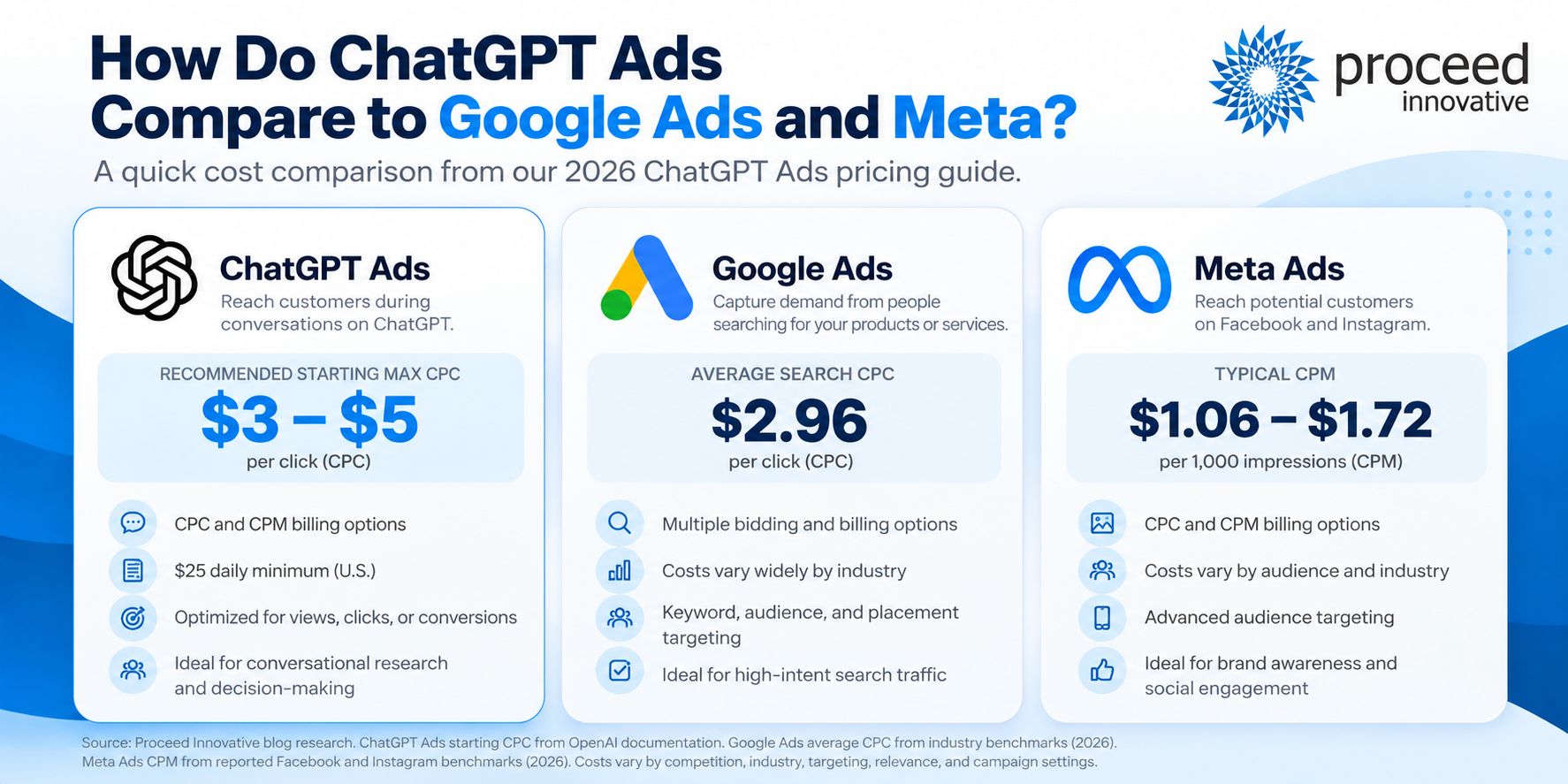
On raw click price, third-party benchmarks cited by Context Hints put Google Search’s cross-industry average CPC at about $2.96 in Q1 2026, slightly below ChatGPT’s recommended starting range. But CPC alone does not determine which channel performs better. Cost per qualified lead does.
For most businesses, the better question isn’t which platform to choose. It’s whether ChatGPT Ads can reach potential buyers earlier in the decision-making process than your Google campaigns, and whether those buyers ultimately convert.
How Do ChatGPT Ads Costs Compare With Meta Ads?
Meta Ads usually cost less per impression, while ChatGPT Ads put you in front of people who are actively asking questions. That tradeoff shapes nearly every comparison between the two.
- CPC vs. CPM: Both platforms support click and impression buying. Third-party benchmarks reported by Digiday put Facebook and Instagram CPMs in the single digits, while reported ChatGPT CPMs have ranged from about $25 to $60.
- Intent: Meta reaches people as they scroll a feed. ChatGPT reaches people who are researching a problem or comparing options, which tends to signal stronger intent.
- Audience and context signals: Meta targets based on interests, behaviors, and demographics. ChatGPT relies on conversation context, intent and, when ads personalization is enabled, select signals from a user’s broader ChatGPT activity.
- Creative requirements: Meta ads lean heavily on visuals and video. ChatGPT ads pair a short headline and description with one image, so the copy has to do more of the work.
- Conversion optimization: Meta’s optimization has years of data behind it. ChatGPT’s conversion campaigns are much newer and still bill per valid click.
- Retargeting: Meta has well-established retargeting tools. OpenAI hasn’t published comparable retargeting options for ChatGPT Ads at this point.
- B2B considerations: Meta can work for B2B awareness, but it’s rarely where buyers go to evaluate vendors. ChatGPT is increasingly where they research software, services, and suppliers, which could give it an edge for considered B2B purchases.
What Factors Affect ChatGPT Advertising Costs?
Six factors account for most of what you’ll pay for ChatGPT Ads. Some are directly within your control, while others are shaped by competition and how the ad auction responds to your campaign.
Competition
More advertisers chasing the same conversations can push auction prices up. Competition is still light in many categories because the platform is new, but that will change as more businesses come on board.
Ad Relevance
OpenAI’s system weighs the context and intent of the conversation against the information in your ad. A relevant ad can win placements at a lower effective price than a generic one with a bigger bid.
Campaign Objective
Views, Clicks, and Conversions campaigns use different buying structures. Views bill on impressions. Clicks and click-billed Conversions campaigns bill on valid clicks.
Bid
Your maximum CPC or CPM bid controls how aggressively you compete. Bid too low and delivery can stall. Bid higher and you raise your ceiling, though the second-price auction means you won’t always pay it.
Landing Page
OpenAI lists the ad’s landing page among the signals its system considers in ad selection and delivery. A page that clearly matches the ad and the conversation helps. A generic homepage usually doesn’t.
Conversion Performance
In conversion-optimized campaigns, the system uses conversion signals to decide which clicks are worth pursuing. Accurate tracking and a conversion event that fires often enough give it more to learn from. OpenAI hasn’t published the exact formula, so treat this as a direction, not a set of rules.
Are ChatGPT Ads Worth It for B2B Companies?
ChatGPT Ads can be worth testing for B2B companies, but it depends on your deal size, sales cycle, and ability to track and qualify leads. There is no universal yes or no.
The channel is most promising when prospects research, compare, and evaluate multiple vendors before they ever speak with sales. That includes:
- High-value services
- Businesses with long consideration cycles
- B2B software
- Professional services and consulting
- Marketing agencies
- Technology companies
- Manufacturers and industrial suppliers whose buyers compare specs and vendors
In each case, buyers are often asking ChatGPT the same questions they’d ask a sales rep, and your ad can show up right next to the answer.

There are real limitations, too:
- It’s a new channel: Ad formats, auction behavior and features are still changing.
- Historical benchmarks are limited: You’ll be relying mostly on your own data.
- Conversion tracking is essential: Without it, you can’t tell good clicks from bad ones.
- Testing takes data: Small budgets may not produce enough conversions to draw conclusions.
- A click is not a qualified lead: A cheap CPC means little if those clicks never turn into sales conversations.
- Some buyers won’t see ads: OpenAI doesn’t show ads on Plus, Pro or Business plans, and many B2B decision-makers use paid accounts at work.
How Much Should a B2B Company Spend on ChatGPT Ads?
Most B2B companies should start with a defined, capped test and increase spending only after the campaign generates qualified conversions. A practical framework looks like this:
Small Test: $500–$1,000
A small test shows whether your ads deliver, whether people click, and whether your landing page holds their attention. Keep it to one or two ad groups built around your strongest service or product. Don’t expect enough conversions to judge lead quality at this stage.
Larger Test: $2,000–$5,000
A larger test gives you enough clicks to compare ad groups and messaging, plus a first look at conversion rates. Run it for at least a few weeks so delivery has time to settle and make sure conversion tracking is live before you start.
Scale After Conversion Data
Increase your budget based on qualified conversions and customer economics, not on clicks or impressions. For B2B, that means tracking the full path:
CPC → lead → qualified lead → opportunity → customer → revenue
Say you pay $4 per click and 4% of clicks become leads. That’s $100 per lead. If one in four leads is qualified, you’re at $400 per qualified lead. If one in five qualified leads becomes a customer, your acquisition cost is $2,000. Whether that’s a great deal or a bad one depends entirely on what a customer is worth to you. (These figures are illustrative, not benchmarks.)
That math is far more useful than CPC alone, and it’s the same math we use to judge any paid channel.
ChatGPT Ads Pricing FAQs
Does ChatGPT charge per click?
Yes, for Clicks campaigns and click-billed Conversions campaigns, you pay per valid click. Views campaigns are billed per 1,000 impressions instead. Conversion-optimized campaigns with click billing still charge for clicks, not conversions.
Is there a minimum budget for ChatGPT Ads?
Yes. In the U.S., the current minimum daily budget is $25 per campaign. Other billing currencies have their own minimums. There’s no large upfront spending commitment for self-serve campaigns.
Can small businesses advertise on ChatGPT?
Yes. Self-serve Ads Manager lets verified businesses launch campaigns with modest budgets. Small businesses should start with a focused test, a strong landing page and conversion tracking in place before spending more.
Are ChatGPT Ads available to everyone?
Not yet. Ads Manager is available in select markets, so check the location picker for your country. On the user side, OpenAI doesn’t show ads to Plus, Pro or Business subscribers, or to users identified as under 18.
Ready to Test ChatGPT Ads?
ChatGPT Ads are still new, which gives businesses an opportunity to build their own performance data while competitors are still trying to figure out where the channel fits. The key is to test with a plan that includes clear goals, relevant landing pages, reliable conversion tracking, and a budget large enough to produce meaningful results.
Proceed Innovative manages OpenAI Ads alongside Google Ads, Microsoft Ads, Meta, and LinkedIn. We can help you determine whether ChatGPT belongs in your paid media mix, build a campaign around your goals, and measure performance based on what matters most: qualified leads and revenue.
Ready to test ChatGPT Ads with a strategy behind them? Explore our PPC marketing services or call (800) 933-2402 for a free consultation.
About the Author: Michael Parziale