For B2B marketing leaders, the question usually is not whether SEO or Google Ads work. It is which one deserves more of the budget right now.
Google Ads can put your company in front of high-intent buyers today and create a more predictable flow of inquiries this quarter. SEO, and increasingly, optimization for AI search, takes longer to build, but it can expand your organic visibility and generate pipeline without requiring you to pay for every click.
Your sales cycle should be one of the biggest factors in deciding where to invest. If you sell a relatively straightforward service with a sales cycle of less than 60 days, paid search may deserve more weight because prospects can move from search to inquiry quickly. If your buyers spend six months or more researching vendors, SEO and AI visibility become more important because much of that evaluation happens before a prospect ever contacts sales, and often before they are ready to click an ad.
That does not mean B2B companies have to choose one and ignore the other. The better question is how to balance the two so paid search captures demand that exists today while organic and AI visibility build demand capture and authority for the future.
This article breaks down the numbers behind that decision, the situations where we recommend weighting one channel heavily over the other, and how we approach the SEO-versus-Google-Ads budget decision at Proceed Innovative.
Why “SEO vs. Google Ads” Is the Wrong Question in B2B
We get some version of this question often, usually from a VP of Marketing who has been asked to justify a budget line. The problem is that the question frames SEO and Google Ads as competing channels reaching the same buyer at the same moment. In B2B, they rarely do.
Here’s what has changed. Research from 6sense, based on a global study of roughly 4,000 buyers, has consistently found that B2B buying teams complete most of their journey before contacting a vendor. In the 2025 edition, first contact occurred at about 61% of the way through the buying journey, compared with 69% the year before. Other research points in the same direction: buying groups often include six to 10 stakeholders, with each person conducting their own research before the group ever engages a vendor.
The finding that should really change your budget is that in roughly 95% of closed deals, the winning vendor was already on the buyer’s shortlist on day one of formal evaluation.
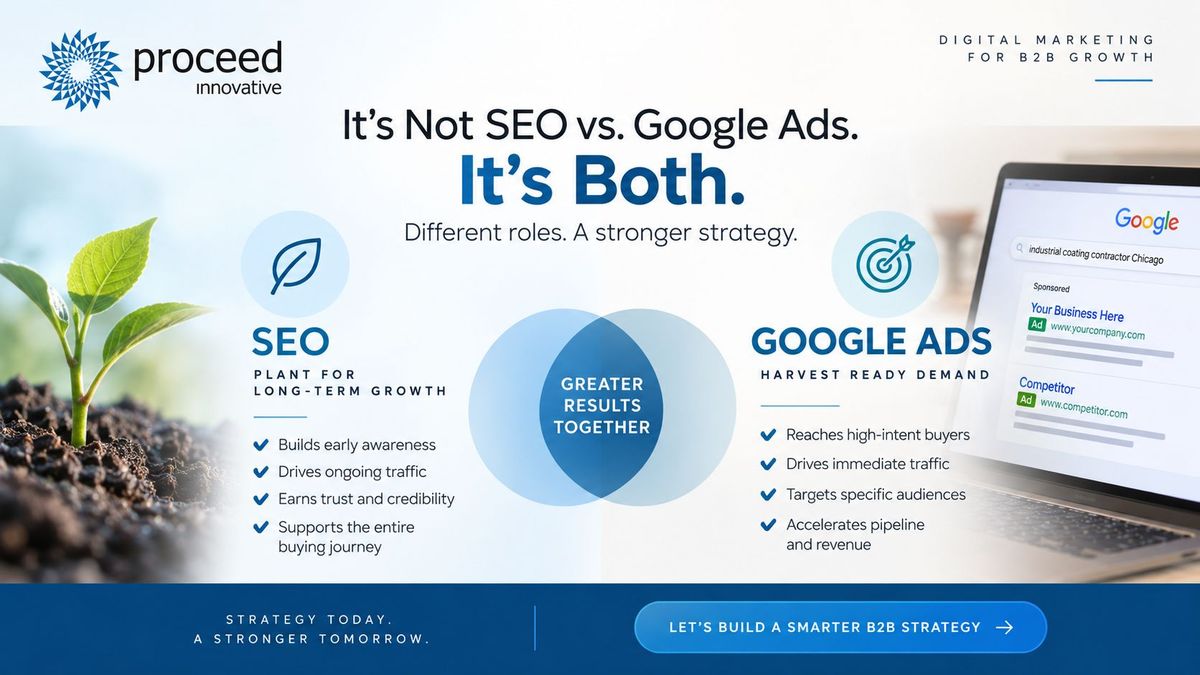
Think about what that means. By the time a prospect searches “industrial coating contractor Chicago” and clicks your ad, the shortlist has usually already been formed.

“Paid search is a harvesting channel in B2B. Organic and AI visibility is a planting channel. Companies that only harvest are always paying market rate for demand somebody else created.”
That is the perspective we bring to every budget conversation as a B2B digital marketing agency working with manufacturers, contractors, home care operators, and professional services firms across the Midwest and nationwide.
What Google Ads Cost B2B Companies in 2026
Benchmark data gives marketing leaders a useful reality check before the first dollar is committed.
Across more than 13,000 search campaigns spanning 23 industries, measured from April 2025 through March 2026, Google Ads averaged $5.42 per click, a 6.64% click-through rate, an 8.18% conversion rate, and a $66.69 cost per lead. Cost per lead declined year over year for the first time since 2020, driven primarily by higher conversion rates rather than cheaper clicks. CPC, meanwhile, has risen roughly 134% since 2016.
B2B tends to run above those averages where it matters most: acquisition cost. Aggregated benchmarks put B2B at roughly $3.33 per click and about $116 per acquisition, while technology comes in closer to $133. B2B SaaS data tells an even sharper story: non-brand search averages $13.75 per click and roughly $207 per lead, compared with $3.12 per click and $34 per lead for branded terms.
Before setting a paid search budget, it is worth looking beyond average CPC and considering conversion rates, lead quality, and your sales cycle. Our Google Ads budget guide breaks down how B2B companies can approach those numbers when setting a realistic monthly budget.
Are You Paying Too Much for Google Ads?
Check how your campaigns are performing, where your budget may be getting wasted, and whether your current setup is attracting the right B2B leads.
Get a Google Ads Audit
Table 1: What a B2B lead costs in Google Ads (2026 benchmark data)
| Segment | Avg. CPC | Conversion rate | Cost per lead |
| All industries, all Google Search | $5.42 | 8.18% | $66.69 |
| B2B services (aggregate) | $3.33 | ~3.0% | ~$116 CPA |
| Technology | $3.80 | 2.92% | ~$133 CPA |
| B2B SaaS, non-brand search | $13.75 | 3.94% | $207 |
| B2B SaaS, branded search | $3.12 | 3.73% | $34 |
Sources: aggregated 2026 Google Ads benchmark datasets (13,000+ campaigns, 23 industries); B2B SaaS figures from 2026 account-level benchmark research.
Look at that last gap. The same platform produces a roughly six-fold difference in lead cost. The only meaningful variable is whether the searcher already knew your name.
That may be the most useful number in this entire article. Branded search is cheap because someone else in your marketing mix created the demand. Non-brand search is expensive because you are renting visibility for demand you did not create.
The distinction matters when you decide where the next marketing dollar should go.
How AI Search Is Changing B2B SEO
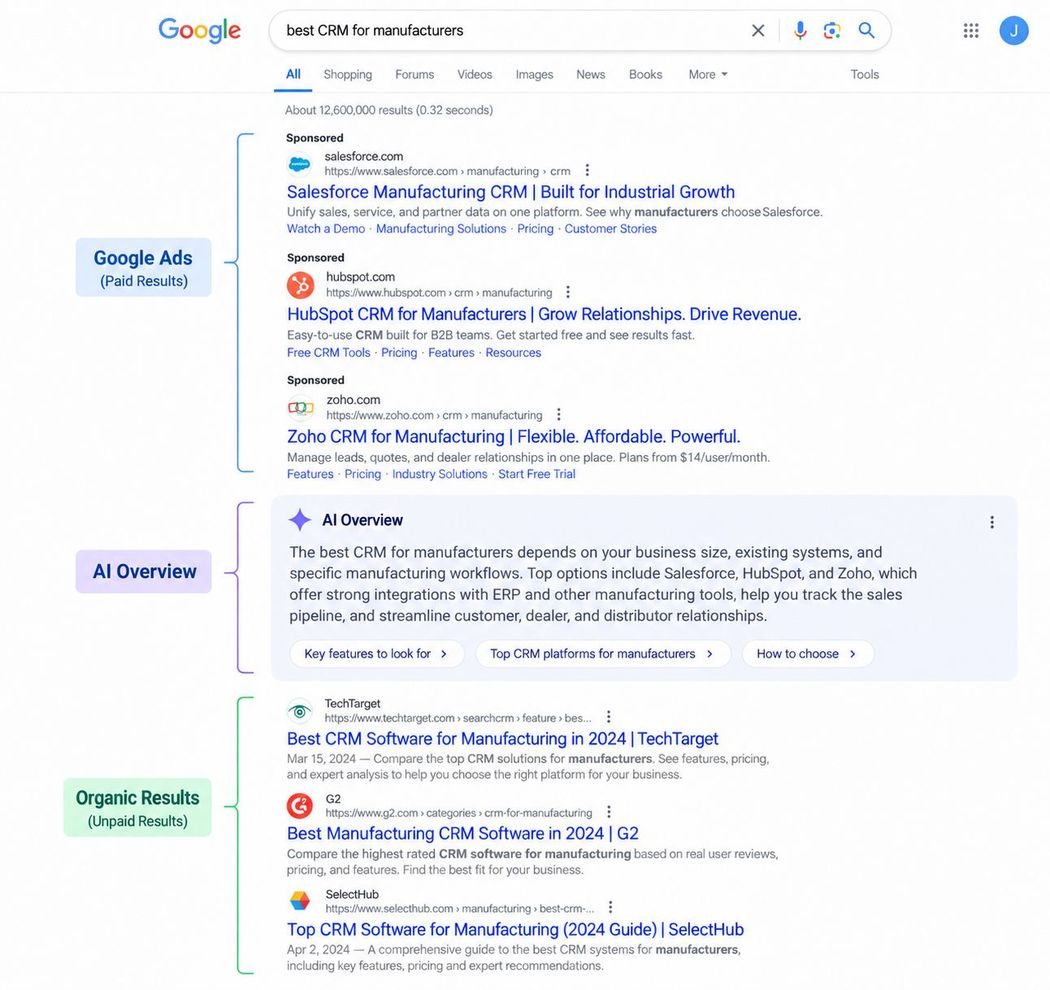
The honest case against SEO in 2026 is that Google is answering more questions itself.
A randomized field experiment found that AI Overviews reduced organic clicks by 38% on queries where they appeared, while zero-click searches rose from 54% to 72%. B2B-specific analysis is even starker: one study of 50 B2B keywords across software, professional services, and growth-stage categories found that 84% now trigger an AI Overview, with organic click rates falling to 50.6% on those keywords versus 60.7% when no AI Overview appeared. BrightEdge tracking puts AI Overview coverage in B2B technology at roughly 82%.
So yes, you get fewer clicks from a ranking, but here’s the part most of the coverage leaves out.
The clicks that remain can be dramatically more valuable. Semrush’s June 2025 study of 500-plus high-value topics found that AI search visitors converted at 4.4 times the rate of traditional organic visitors. Ahrefs’ first-party data was even more striking: AI referrals accounted for just 0.5% of its traffic but generated 12.1% of signups. Seer Interactive’s multi-vertical data showed ChatGPT referral traffic converting at nearly 15.9%, compared with 1.76% for Google organic.
An AI answer does much of the comparison work before the click. The person who reaches your site has already seen your company evaluated alongside three competitors in a neutral summary. They are not browsing. They are verifying.
Table 2: What each channel does in a B2B buying cycle
| Buying stage | What the buyer is doing | Google Ads | SEO + AI search |
| Problem identification | Naming a problem, no vendors in mind | Low impact | High impact |
| Solution exploration | Building the day-one shortlist | Low impact | High impact |
| Requirements building | Comparing approaches, specs, pricing models | Moderate | High impact |
| Supplier selection | Narrowing to two or three | High impact | Moderate |
| Validation | Checking reviews, credentials, case studies | Moderate | High impact |
| Consensus | Selling internally to six to ten stakeholders | Low impact | High impact |
Marketing leaders who only fund the “supplier selection” row wonder why their cost per lead climbs every year. Competitors are quietly winning the four rows above it.
Our AI search visibility work is built around those upper rows, because that’s where shortlists get written.
Is Your Brand Showing Up in AI Search?
See how often your company appears in AI-generated answers and whether competitors are being recommended instead.
Get Your Free AI Visibility Audit
The Proceed Framework: Floor, Ceiling, and the Three-Question Test
We stopped running channel-versus-channel comparisons for clients years ago. Here’s what we use instead.
Google Ads sets your floor.
It’s the channel you can turn up on Monday and measure by Friday. It protects your brand terms, fills gaps while organic visibility builds, and gives you a controllable baseline of inquiries. Turn it off, and the leads stop that day. Our Google Ads management team in Chicago treats paid search as the reliable base of the pipeline, not the growth engine.
SEO and GEO raise your ceiling.
Every new ranking page, every citation in an AI answer, and every piece of content a buying committee shares internally can generate additional demand without an incremental cost per visit. As visibility compounds, lead costs can fall with volume, the opposite of how a search auction works.
For a deeper look at how this works across technical SEO, content, authority, and search visibility, see our guide to mastering B2B SEO.
Then we ask three questions to determine the right split.
1. How long is your sales cycle?
Under 60 days, paid search can capture buyers while you still have time to influence the decision. Over six months, much of the decision happens during research you will never see in GA4, making organic and AI visibility far more important.
2. How well-defined is your category vocabulary?
If buyers already use a clear, established term for what you sell, SEO can compound quickly. If you offer something buyers do not know how to name yet, there may be little paid search demand to capture, and your content has to educate the market first.
3. What does being absent cost you?
Some markets punish invisibility more than others. A manufacturer with three national competitors can lose a place on every shortlist by being absent. A local contractor competing with 40 others may lose one job.
Table 3: Starting budget allocation by profile (Proceed Innovative model)
| Company profile | Google Ads | SEO + GEO | Rationale |
| Long cycle, established category (industrial, manufacturing) | 30% | 70% | Shortlist formed months before any ad click |
| Short cycle, high-intent local demand (contractors, field services) | 55% | 45% | Buyers search and call the same week |
| New category or new product line | 60% | 40% | Paid buys learning data while content builds the category |
| Established brand defending share | 35% | 65% | Brand terms are cheap; the fight is upstream |
| Launching in a new metro or territory | 65% | 35% | Ads produce presence on day one; organic follows |
This is a starting point, not a prescription. We reset allocation quarterly against actual pipeline data, not impressions.
Measure the Pipeline, Not the Last Click
Most B2B attribution reports are wrong in a predictable way, they over credit the last click. In a paid-heavy search environment, the last click is often Google Ads.
That is why we do not judge SEO, paid search, or AI visibility by the number of leads each channel claims in a monthly attribution report. Instead, we look at the metrics that tell us whether marketing is creating and influencing revenue:
- Blended CAC by channel over 12 to 24 months, not monthly cost per lead. SEO can look terrible in month three and become one of your most efficient acquisition channels by month eighteen. A short reporting window practically guarantees you cut it before it compounds.
- Branded search volume over time. This is one of the clearest signals that upper-funnel marketing is creating demand. When more buyers search for your company by name, you are relying less on paid search to capture non-brand demand.
- Pipeline from accounts with prior anonymous site activity. This helps expose the dark funnel, the research and evaluation that happens before a prospect fills out a form or identifies themselves in your CRM.
- AI citation presence for core category terms across Google AI Overviews, ChatGPT, Perplexity, and Gemini. If competitors are being recommended while your company is absent, they are influencing the shortlist before your sales team ever gets a chance to compete.
- Lead-to-opportunity rate by channel. Paid search may win on lead volume while losing on lead quality. You need both numbers side by side, or the comparison is meaningless.
The goal is not to make SEO look better than paid search. It is to stop measuring channels in a way that makes long-term marketing look bad by definition.
Four Mistakes That Waste B2B Budget in Both Channels
The biggest waste is not always choosing the wrong channel. It is using the right channel for the wrong job, or measuring it in a way that makes good marketing look ineffective. We see four mistakes repeatedly.
Bidding on broad category terms with a demo-request landing page.
A buyer who is three months from a decision probably is not ready to book a sales call. You paid $13 for the click and gave them one option they were never going to take. Broad, early-stage searches need content that helps the buyer research, compare, and understand the problem, not a form demanding a commitment.
Writing content for search volume instead of the buying committee.
The person who finds your article may not be the person who signs the contract. Your champion still has to make the case internally to five other stakeholders. The page that gives them technical details, proof, comparisons, and answers they can share internally will often create more pipeline than the page that ranks for a high-volume keyword nobody with budget searches.
Measuring SEO by traffic in a zero-click market.
Rankings and sessions are becoming less predictive as Google and AI platforms answer more questions without sending the user to a website. That does not make organic visibility less valuable; it changes what you need to measure. AI citations, branded search growth, qualified engagement, and pipeline influence tell you far more than raw traffic alone.
Treating paid and organic as separate teams.
Your Google Ads search-term report may be some of the best keyword research your content team will ever receive. Every term represents an actual search, and the best terms come with data on commercial intent and conversion. Yet many companies never share that intelligence with the people responsible for SEO and content. The same works in reverse: organic data can show which topics and pages are earning sustained interest, giving the paid team better ideas for campaigns and landing pages.
The goal is not to make SEO and Google Ads compete for credit. It is to make the two channels smarter together.
SEO vs. Google Ads for B2B Companies FAQs
Should B2B companies invest in SEO or Google Ads first?
If you need pipeline this quarter, start with Google Ads on bottom-funnel and branded terms while SEO is built in parallel. If you have six months of runway and a defined category, start with SEO and use a small paid budget to test which keywords convert.
What percentage of a B2B marketing budget should go to SEO vs. PPC?
Most B2B companies land somewhere between 30/70 and 60/40 depending on sales cycle length, category maturity, and competitive pressure. Long-cycle industrial and manufacturing clients typically weight toward SEO; new market entries weight toward paid.
How long does B2B SEO take to generate leads?
Typically four to six months for early movement and nine to twelve months for meaningful pipeline contribution in competitive B2B categories. Technical fixes and existing-page optimization can produce gains sooner. New-domain or new-category work takes longer.
Do AI Overviews make B2B SEO less valuable?
They make traffic-based SEO less valuable and visibility-based SEO more valuable. With 84% of B2B keywords triggering AI Overviews and AI-referred visitors converting at roughly 4.4 times the rate of standard organic, the goal shifts from ranking to being the source the AI cites.
Is Google Ads still worth it with rising B2B CPCs?
Yes, for branded terms, bottom-funnel commercial keywords, competitor conquesting, and geographic expansion. It stops being worth it when non-brand cost per acquisition exceeds what a closed deal is worth, which is why the brand versus non-brand split needs to be reviewed quarterly.
Can SEO and Google Ads data be used together?
Yes, and it’s the most underused tactic in B2B. Paid search query data identifies which terms convert before you invest months in ranking for them, and organic ranking gains let you reduce bids on terms you now own.
The Right B2B Search Strategy Is Not Either/Or
If you’re a marketing leader trying to defend or reallocate a budget, the decision isn’t SEO versus Google Ads. It’s whether your current mix reflects how your buyers make decisions, or how your attribution tool happens to report them.
Proceed Innovative has been answering that question for B2B companies since 2008 for clients across manufacturing, industrial services, contracting, home care, and professional services nationwide.
Two places to start:
- Explore our Chicago B2B SEO services to see how we build organic and AI search visibility that feeds qualified pipeline over the long term.
- Review our pay-per-click management services if you need a predictable floor of inquiries while that visibility gets built.
Want us to model the split for your specific sales cycle and category? Request a free proposal or call (800) 933-2402. We’ll show you what your current B2B lead generation mix is costing you and what a better one looks like.
1501 Woodfield Road, Suite 112E, Schaumburg, IL 60173
520 W Erie St, Suite 440, Chicago, IL 60654
About the Author: Yashasvi Rochwani