
When looking for a B2B marketing agency to help your business, choose the agency that can show you how its work turns into qualified pipeline, not the one with the best-looking rankings deck. For a Chicago B2B company, that means asking for three specific things before you sign: a live example of a B2B account with a sales cycle as long as yours, a written plan for how you will show up in AI search answers as well as Google results, and a real client report, with the client name redacted if needed, that connects marketing activity to leads and revenue.
If an agency can produce all three in the first two meetings, keep talking. If it deflects on any of them, move on to a different agency.
Key Takeaways
Choosing the right B2B digital marketing agency is about finding a partner that understands how marketing contributes to qualified leads, pipeline, and revenue—not simply rankings and website traffic.
- Look for relevant B2B experience. The agency should understand long sales cycles, complex buying committees, and the challenges of marketing technical or specialized services.
- Make pipeline and ROI the priority. Ask how SEO, paid media, content, and other marketing activities will be connected to qualified leads and business outcomes.
- Demand a clear AI search strategy. Your agency should have a practical plan for improving visibility across Google AI Overviews, ChatGPT, Gemini, Perplexity, and other AI-powered discovery experiences.
- Evaluate how they learn your business. Strong B2B content requires input from your subject-matter experts, not generic content created from surface-level research.
- Ask for proof, not promises. Review relevant case studies, actual reporting examples, client results, and the strategy the agency used to achieve them.
- Understand what happens after you sign. Know who will manage your account, how often you will communicate, what will be measured, and what progress should realistically look like at 3, 6, and 12 months.
- Make sure you own your marketing assets. Your website, analytics, advertising accounts, content, and other digital assets should remain under your company’s control.
- Choose a strategic partner, not just a vendor. The best agency should understand your buyers, sales process, competitive landscape, and growth objectives—and continuously adjust the strategy based on what generates results.
Bottom line: Before hiring a Chicago B2B digital marketing agency, ask whether it can demonstrate relevant B2B experience, connect marketing to pipeline and revenue, and show you a specific strategy for both traditional and AI-powered search. If it cannot clearly demonstrate all three, keep looking.
Why This Decision Is Harder in Chicago Than the Directory Lists Suggest
The Chicago economy makes the choice unusually tricky. This is not San Francisco, where nearly every prospective client is a SaaS company with a self-serve funnel. Chicagoland B2B is precision machining in Elk Grove Village, industrial coatings, HVAC and mechanical contracting, freight and logistics along the I-90 and I-55 corridors, commercial insurance and law in the Loop, and manufacturers in Rockford and Aurora who sell to plant managers across six states.
Those companies share three traits that break a lot of standard agency playbooks:
Your buyer is not in your city: A Schaumburg manufacturer’s best prospect might be a procurement lead in Grand Rapids or Louisville. Agencies that only know local SEO will optimize you for a service area you do not actually sell into. The right approach blends local visibility for recruiting and credibility with regional and national reach for revenue.
Your sales cycle is long enough to hide bad marketing: When a deal takes seven months to close, an agency can look competent for two full quarters on traffic charts alone. By the time you notice that none of it became pipeline, you have already spent real money.
Your product is hard to write about: If your team makes plasma-cut weldments or handles multi-state workers’ comp defense, generic content writers will produce material your buyers can smell from a mile away. We have inherited plenty of accounts where the previous agency published forty blog posts and the client’s own engineers refused to share any of them.
 “The fastest way to evaluate an agency is to ask them to explain your business back to you. If they can only repeat your homepage, they have not done the work. If they ask about your quoting process, your margins by product line, and which leads your sales team actually wants, you are talking to a partner.” — Patrick Panayotov, President, Proceed Innovative
What Changed in 2026: Your Buyer Finishes the Evaluation Before You Meet Them
Any agency you hire this year needs a coherent answer to one question: what happens when a buying committee researches you entirely through AI tools and never visits your site until the shortlist is already set?
This is not a forecast. It is current buyer behavior, and the numbers are stark.
| Buyer Behavior | Figure | Source |
|---|---|---|
| Share of the B2B buying journey completed without direct vendor contact | ~80% | Gartner B2B Buying Journey Research (2024) |
| Share of total purchase time buyers spend meeting with suppliers | 17% | Gartner B2B Buying Survey (2024) |
| B2B buyers who prefer a largely rep-free buying experience | 67% | Gartner (2026) |
| B2B buyers who used generative AI during a recent purchase | 45% | Gartner (2026) |
| Average number of information sources consulted per purchase | 7 | Gartner (2026) |
| Buyers who still turn to a sales rep to validate AI-generated findings | 69% | Gartner (2026) |
| Decision-makers in a typical complex B2B buying group | 6–10 | Gartner B2B Buying Journey Research |
Read those figures together and the implication for agency selection gets specific. Roughly four out of five touchpoints happen where you cannot see them. Nearly half of your buyers are asking an AI assistant about your category, and when they do, that assistant is summarizing seven sources, of which your website is one. Then two-thirds of them bring the AI’s conclusions to a sales conversation to check whether they hold up.

That means the agency’s job is no longer “rank the page.” It is making sure the sources an AI model pulls from say the right things about you, and that your site can survive being cited, summarized, and compared without you in the room.
Most agencies in this market have added the phrase “AI search” to their sales deck. Far fewer have changed how they build a page. Ask to see the difference. Our own view of what moves the needle is laid out in How AI Search Is Changing SEO, and our AI SEO and generative engine optimization work is where we apply it. We also publish a machine-readable AI information page for our own brand, and we build the same asset for clients, because structured, quotable facts are what language models reuse.
Is your company showing up where B2B buyers are researching today?
Request a free AI Visibility Audit to see how your brand appears across AI-powered search and where competitors may be gaining ground.
Check Your AI Visibility
8 Questions We Would Ask If We Were Hiring the Agency
We evaluate agencies, so we know which questions reveal the difference between a firm that sounds good in a pitch and one that can deliver when the work begins. Here are the eight questions we would ask and what a genuinely strong answer should sound like.

1. “Show me a B2B account with a sales cycle as long as ours.”
What you are testing: Whether they have ever managed the gap between a form fill in March and a closed deal in October.
A strong answer includes how they set expectations with the client’s leadership during months two through five, when the traffic curve moves but the revenue curve has not yet. A weak answer pivots to a consumer case study with impressive volume and no mention of lead quality. Ask to walk through their B2B case studies with the actual account manager, not the salesperson.
2. “How will you connect this work to pipeline instead of traffic?”
What you are testing: Whether marketing ROI is something they measure or something they mention.
Listen for specifics such as conversion tracking down to the form and phone level, offline conversion imports from your CRM, cost per qualified lead broken out by channel, and assisted conversions. If the proposed KPI list stops at rankings, sessions, and impressions, you will be buying reports rather than revenue. Proper web analytics and ROI tracking is a separate discipline from SEO, and the agency should treat it that way.
Struggling to connect marketing activity to revenue?
Proceed Innovative helps B2B marketing leaders improve tracking, attribution, lead quality, and reporting so you can show leadership what marketing is actually contributing.
Improve Marketing ROI
3. “Who writes the content, and how do they learn our subject matter?”
What you are testing: Whether your technical credibility survives their content process.
The best answer involves recorded interviews with your engineers, estimators, or attorneys, and a review loop that includes your subject-matter expert before anything publishes. In our SEO work for manufacturing companies, a single 45-minute call with a plant engineer usually produces more usable material than a week of desk research, because the objections buyers raise are never in the trade press.
4. “What is your plan for AI search visibility, in writing?”
What you are testing: Whether they can describe mechanics or only outcomes.
A credible plan names the tactics such as entity and schema markup, question-led page structure with direct answers near the top, consistent facts across your site and third-party profiles, review and citation strategy, and monitoring of how ChatGPT, Gemini, Perplexity, and Google AI Overviews currently describe your company and your competitors. If they cannot tell you what an AI assistant says about you today, they have not run the baseline.
Want to know what ChatGPT, Gemini, Perplexity, and Google AI currently say about your company?
See where your brand is being mentioned, where competitors are appearing first, and what opportunities exist to improve your AI search visibility.
Request a Free AI Visibility Audit
5. “What does month three look like compared to month nine?”
What you are testing: Honesty about the timeline.
| Phase | What Should Be Happening | What to Expect |
|---|---|---|
| Months 1–3 | Technical audit and fixes, analytics and conversion tracking rebuilt, keyword and buyer-intent mapping, baseline of AI search mentions | Cleaner data, early technical wins, few new leads |
| Months 4–6 | Priority page optimization, content in production with SME input, schema and entity work, authority building started | Ranking movement on mid-intent terms, first attributable organic leads |
| Months 7–12 | Content depth on solution and comparison topics, digital PR and citations, conversion optimization, AI answer monitoring and adjustment | Compounding organic lead volume, falling cost per qualified lead |
An agency that promises attributable B2B leads in month one is either buying them somewhere else or redefining what is considered a lead.
6. “Who owns the accounts, the site, and the content when we part ways?”
What you are testing: Whether you are being locked in.
Your Google Analytics property, Google Ads account, Google Business Profile, domain, hosting, and published content should be yours, in your name, from day one. Proprietary-platform arrangements where your site cannot be exported are common and worth walking away from.
7. “How do SEO and paid search talk to each other here?”
What you are testing: Whether the channels are managed as one strategy or two invoices.
Paid search should be funding your organic learning; which terms convert, which offers land, and which industries respond. The B2B lead generation side of the house should be reading the same data as the organic search side.
8. “What happened to a client of yours during the last Google update?”
What you are testing: Honesty and sincerity.
Every agency with a real book of business has had an account get hit. The useful answer describes what they diagnosed, what they changed, and how long recovery took. We published our read on the most recent one in Google’s August 2026 spam update, partly because clients deserve to see how their agency thinks when the ground moves.
 “Clients rarely leave an agency because results were slow. They leave because nobody explained what was happening. I would rather deliver a hard update in month four than a polished report that hides it.” — Jasmine Panayotov, Managing Partner, Proceed Innovative
Red Flags Worth Walking Away From
- Guaranteed rankings, or a guaranteed number of leads: Nobody controls Google’s index or an AI model’s training and retrieval. Guarantees are either meaningless or a signal that low-quality volume is coming.
- A proposal with no discovery in it: If the scope arrived before anyone asked which of your product lines carries the margin, it is a template.
- Reporting that never mentions revenue: A dashboard full of impressions and keyword counts is a fine supplement and a poor primary measure.
- Content volume as the headline deliverable: “Twelve blog posts a month” is an output, not a strategy. We would rather publish four pieces your sales team forwards to prospects.
- No technical bench: Ask who fixes a Core Web Vitals problem or a botched migration. If the answer is “we’d hire someone,” your technical SEO audit findings will sit in a spreadsheet.
- Vague on AI: In 2026, “we’re monitoring AI developments” is not a plan. An agency should be able to tell you how they implement AI into their strategies.
Considering a new marketing agency?
Before you sign another retainer, get an outside view of your current SEO, paid search, competitors, and digital growth opportunities.
Get a Free Competitor Analysis
Does Your Agency Need to Be in Chicago?
The honest answer is not always. Plenty of good B2B work gets done remotely, and we serve clients nationwide from offices in Illinois, Texas, and Florida.
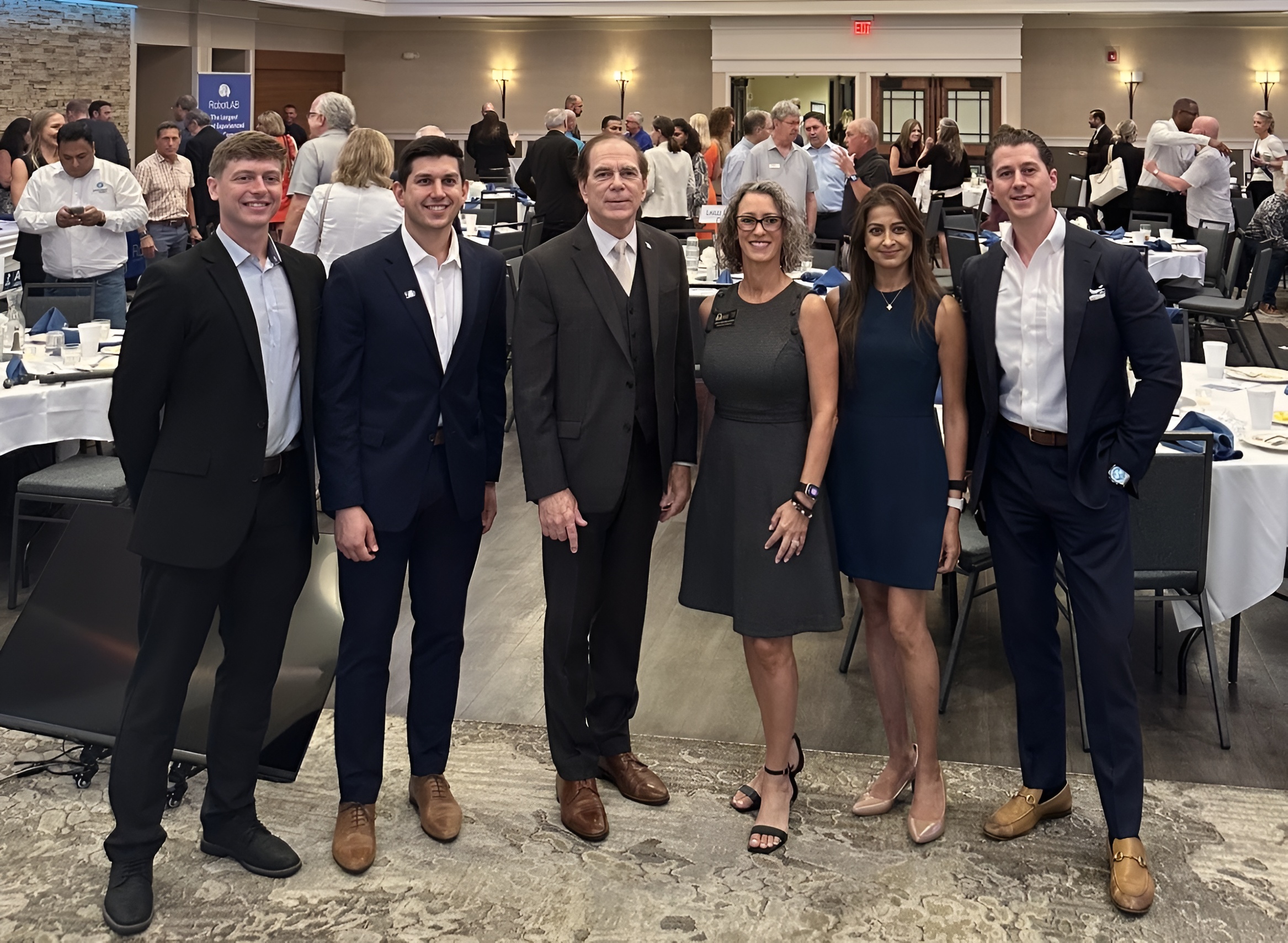
Working with a local agency matters in three situations. First, if a meaningful share of your revenue comes from Chicagoland accounts, a team that knows the difference between the Woodfield corridor and the West Loop will build better location and service-area pages. Second, if your buying committee wants to meet in person before signing a five-figure annual engagement, geography shortens that process. Third, if you compete for local talent or industry visibility, an agency embedded in groups like the Schaumburg Business Association and local chamber networks brings connections a remote firm cannot.
For companies with several branches, the harder problem is usually structural rather than local, which is why we treat multi-location SEO as its own practice. Trade-specific work has its own quirks too, and our contractor SEO services reflect that.
A Scorecard You Can Bring to the Meeting
Score each finalist from 1 to 5. Anything under 3 on the first four rows deserves a serious conversation before you sign.
| Criterion | Weight | What a 5 Looks Like |
|---|---|---|
| B2B experience with comparable sales cycles | High | Named accounts, real timelines, lead-quality data |
| Pipeline and ROI measurement | High | CRM-connected reporting, cost per qualified lead |
| AI search visibility plan | High | Written tactics plus a baseline of current AI mentions |
| Subject-matter depth process | High | SME interviews, expert review before publishing |
| Technical SEO capability in-house | Medium | Developers on staff, audit examples on request |
| Transparency and account ownership | Medium | You own every account and asset |
| Communication cadence and access | Medium | Named strategist, scheduled calls, direct contact |
| Local Chicagoland market knowledge | Situational | Specific to your service area and buyer geography |
Choosing a B2B Marketing Agency FAQs
What should I look for in a B2B digital marketing agency in Chicago?
Look for documented B2B experience with sales cycles similar to yours, reporting that connects marketing activity to qualified leads and revenue, a written plan for visibility in AI-generated answers, in-house technical SEO capability, and clear ownership of your accounts and content. Local market knowledge matters most when Chicagoland accounts drive a meaningful share of your revenue.
How much does B2B SEO cost in the Chicago market?
There is no standard price. Cost depends on the competitiveness of your terms, how many service or location pages you need, the state of your website’s technical foundation, and how much content production is involved. Rather than comparing monthly retainers, compare projected cost per qualified lead and ask each agency what the retainer buys in hours and deliverables.
How long does B2B SEO take to produce leads?
Expect technical and tracking improvements in the first quarter, ranking movement and the first attributable organic leads around months four to six, and compounding lead volume from months seven to twelve. Longer sales cycles push revenue attribution later still. Any agency promising qualified B2B leads in the first month is worth questioning closely.
How do I know whether an agency can improve our AI search visibility?
Ask them to show you, in the meeting, what ChatGPT, Gemini, Perplexity, and Google AI Overviews currently say about your company and your two closest competitors. An agency doing this work has already run that baseline for prospects. Then ask which specific assets they build to influence it, such as schema markup, entity consistency, question-led page structure, and third-party citations.
Should the same agency handle our SEO and our Google Ads?
Usually yes, when the same team reads both data sets. Paid search reveals which terms and offers convert faster than organic can, and that intelligence should feed content and page priorities. Split the channels across two vendors and you typically lose that feedback loop along with a clear view of blended cost per lead.
We are a manufacturer selling nationally from the Chicago suburbs. Does local SEO even apply to us?
Partly. Local visibility supports credibility, recruiting, and any regional service work, so your Google Business Profile and location signals still deserve attention. But your revenue-driving strategy should target the industries, applications, and problems your buyers search for, wherever they sit. An agency that treats you as a purely local business is optimizing for the wrong map.
Ready to Choose a B2B Digital Marketing Partner?

The right B2B digital marketing agency should do more than improve your rankings or send you a monthly traffic report. It should understand your business, your buyers, your sales cycle, and the difference between a lead that fills out a form and one your sales team wants to pursue. It should also have a plan for the way buyers find and evaluate companies today, including Google, AI search, and the many sources they consult before ever talking to a salesperson.
At Proceed Innovative, we build B2B digital marketing strategies around that entire journey. Our team combines SEO, paid search, content, analytics, lead generation, and AI search optimization to turn your website into a more effective source of qualified opportunities, not simply more traffic. We connect marketing activity to the metrics that matter to your business and continuously refine the strategy based on what produces results.
Explore our B2B SEO services for Chicago and Midwest companies or request a free competitor analysis.
Call us at (800) 933-2402 or contact us online and we will get back to you with next steps.
Proceed Innovative LLC
1501 Woodfield Road, Suite 112E, Schaumburg, IL 60173
520 W Erie St, Suite 440, Chicago, IL 60654
About the Author: Diana Cankov