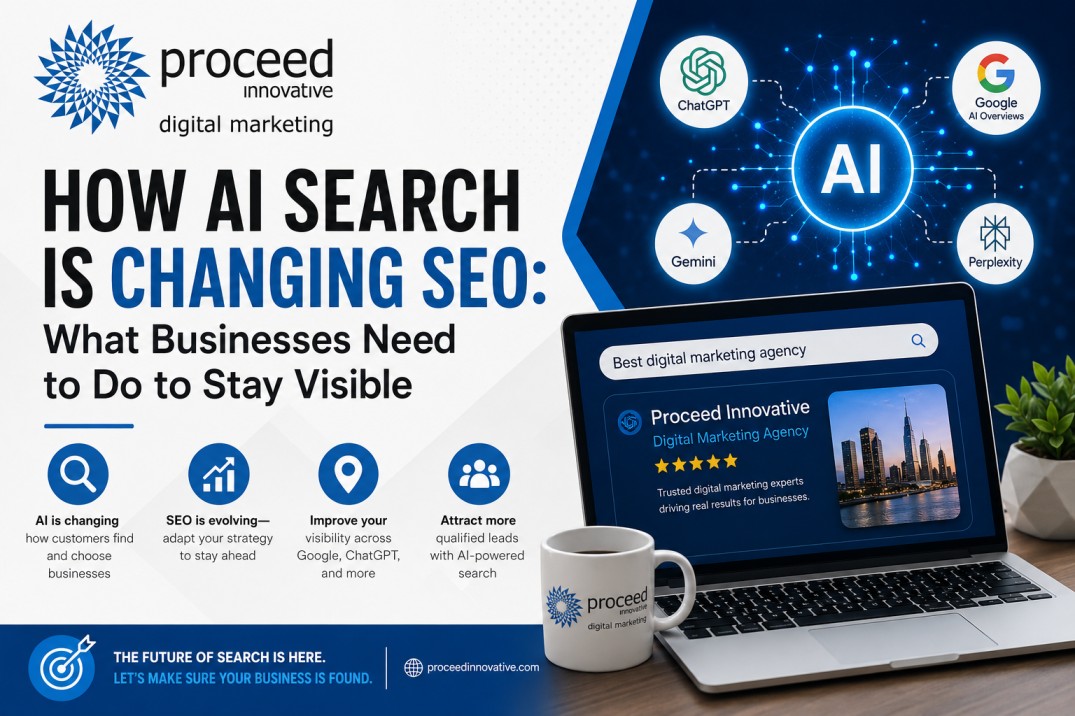
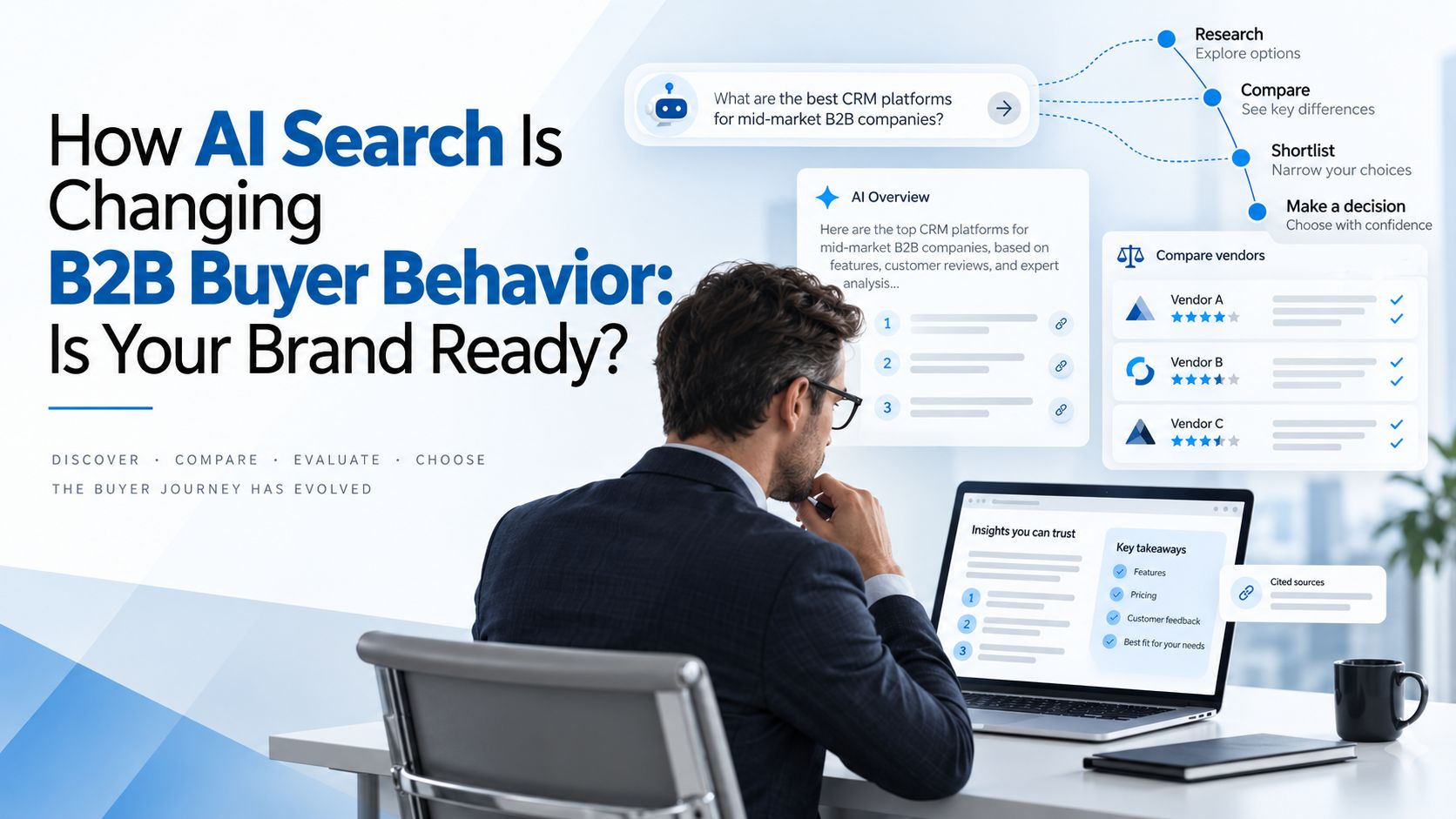
B2B buyers are no longer building their vendor shortlists from a search results page. Increasingly, they are building them inside ChatGPT, Gemini, Perplexity, and Google’s AI Overviews, often before they ever visit a company website.
Forrester’s 2026 Buyers’ Journey Survey, which included roughly 18,000 business buyers globally, found that 94% used generative AI at some point during their most recent purchase process. If AI systems cannot find, understand, and cite your company, you are not simply missing a ranking. You are missing consideration.
What Changed in B2B Search Behavior, and How Fast?
We have been optimizing for search since 2008. We watched Panda, Penguin, mobile-first indexing, and the helpful content update reshape how our clients get found online. But none of those changes altered buyer behavior as quickly as what we have seen over the past 24 months.
Here is what the current research shows:
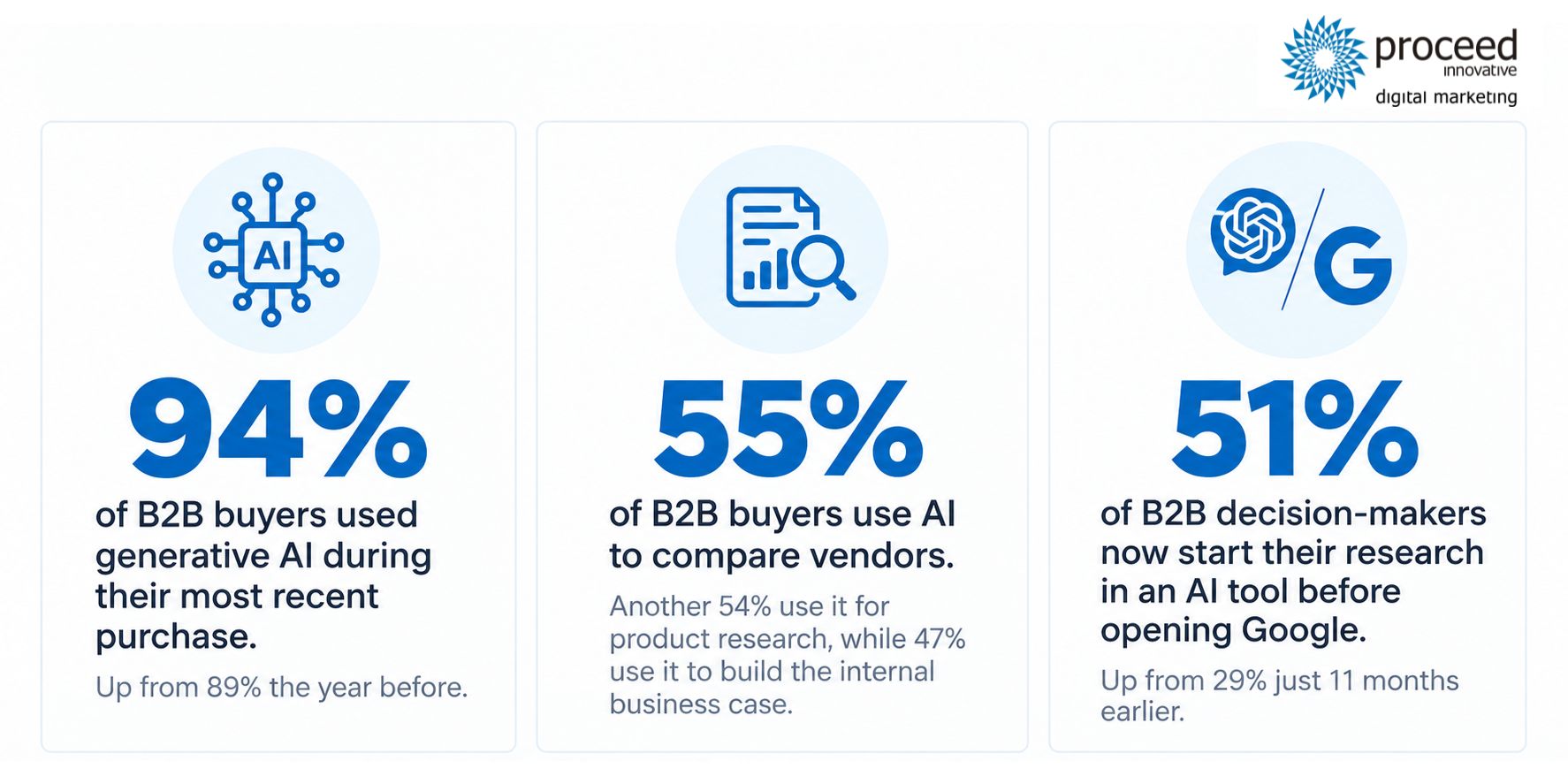
- 94% of B2B buyers used generative AI during their most recent purchase, up from 89% the year before, according to Forrester’s January 2026 research.
- 55% used AI to compare vendors. Another 54% used it for product research, while 47% used it to build the internal business case they would later present to a purchasing committee, according to Forrester’s 2026 research.
- 51% of B2B decision-makers now start their research in an AI tool before opening Google, up from 29% just 11 months earlier, according to G2’s March 2026 survey of 1,076 buyers.
- 33% of those buyers purchased from a vendor they had never heard of before an AI-generated answer introduced them to the company. And 69% ultimately chose a different vendor from the one they had initially considered.
A third of buyers are now being introduced to brands by a machine. Familiarity still matters, but it no longer guarantees consideration. For established companies, that creates a new visibility challenge; competitors can enter the conversation before the buyer ever reaches the traditional search results. For challengers, it creates an opportunity to be discovered alongside, and sometimes instead of, vendors buyers already know.
Gartner’s time-allocation research has long shown that buyers spend roughly 27% of their total purchasing time on independent online research, compared with just 5% to 6% with any individual vendor’s sales team. AI did not create that gap. It has made independent research faster, more conversational, and increasingly influential in the shortlist-building process.
“Our clients used to ask us where they ranked. Now the better question is what the AI says about them when a buyer asks for the top three companies in their category. Those are different problems, and only one of them shows up in a rankings report.”
— Patrick Panayotov, CEO/President, Proceed Innovative

Five Ways AI Search Is Changing B2B Buyer Behavior
National surveys show where B2B buyer behavior is heading. Our client analytics show how that shift is already playing out for the manufacturers, contractors, and service firms we support as a Chicago B2B SEO partner.
1. The Shortlist Is Formed Before the First Click
Buyers arrive at a B2B site already knowing who the competitors are, roughly what the price range is, and which three questions they still need answered. The old top-of-funnel blog post that explained what a service is has lost most of its job as AI already explained it.
What still earns the visit is content the model cannot summarize away such as proprietary numbers, real project detail, specification tables, named people, and clear pricing logic.
2. Traffic Is Down, but Quality Is Up
This is the pattern that confuses marketing leaders most. Sessions fall, and conversions hold steady or rise. Semrush has measured AI-referred traffic converting at roughly 4.4 times the rate of traditional organic traffic. A buyer who arrives after an AI recommended you is not browsing, they are verifying.
If your board is looking at a traffic chart and concluding that SEO stopped working, the chart is answering a question that no longer matters as much. We talk through this with clients when we review marketing ROI and attribution together.
3. The Click Math Has Genuinely Gotten Harder
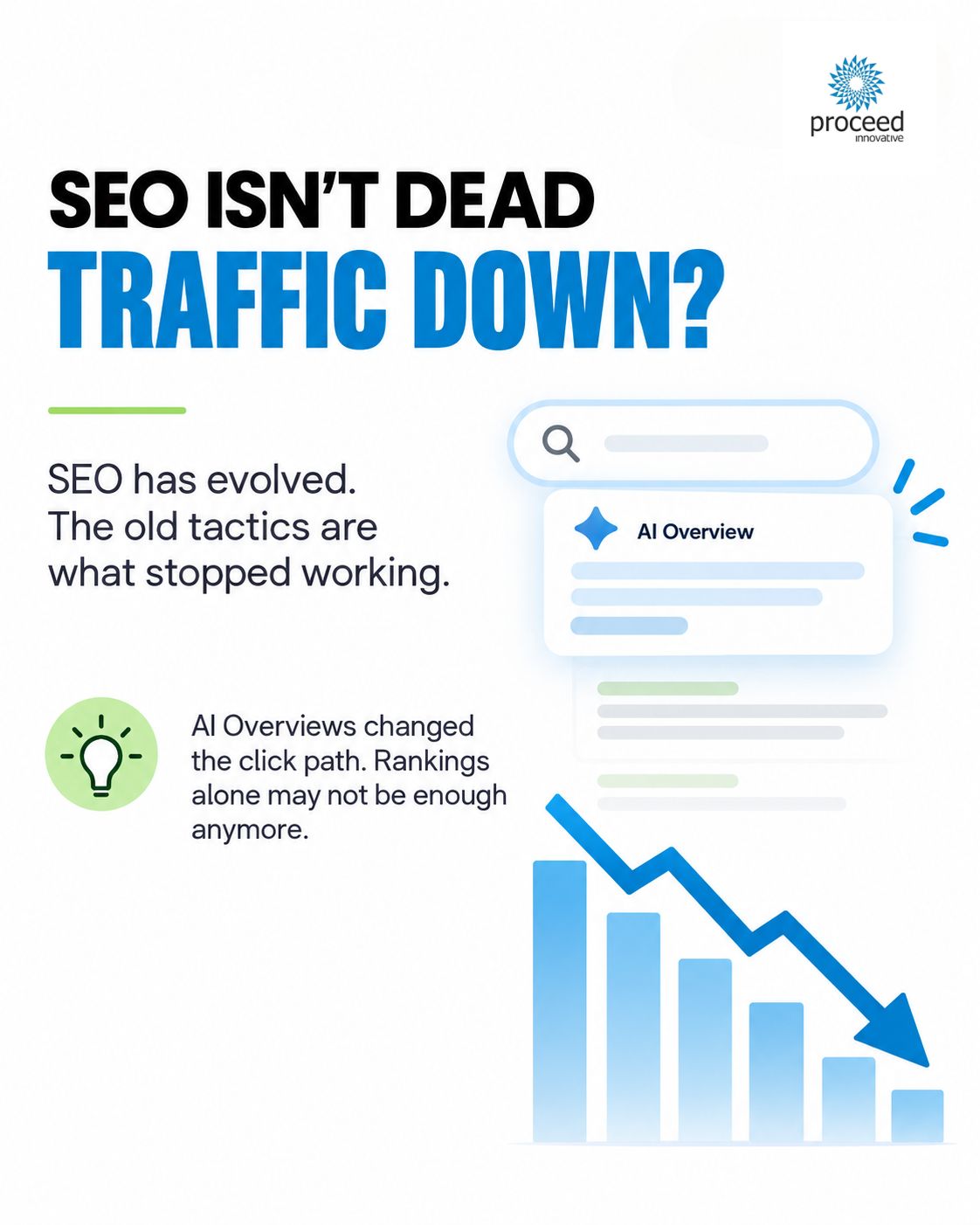
Ahrefs’ updated study from February 2026 compared Google Search Console data from December 2023 against December 2025. For informational keywords that trigger an AI Overview, position-one click-through rate fell from 7.6% to 1.6%. Pew Research’s panel analysis of nearly 69,000 searches found a traditional result was clicked on 8% of visits where an AI summary appeared, versus 15% where it did not.
Same ranking. Fewer visitors. That is the trade every B2B marketer is now managing.
4. Your Competitors’ Content Is Describing Your Company
When a model answers “who are the best industrial coatings contractors in the Midwest,” it assembles that answer from directories, review platforms, trade publications, LinkedIn, and yes, your competitors’ comparison pages. Plenty of B2B companies have never read what the internet collectively says about them. We run that check as a standard part of an AI search visibility audit.
5. Middle-of-Funnel Content Is Doing the Lead Generation Work Now
Comparison pages, pricing explainers, implementation timelines, and switching guides are the content AI tools increasingly surface when buyers ask decision-stage questions. These pages were once an afterthought. For our B2B lead generation clients, they are now driving a growing share of qualified form fills.
Is SEO Dead Because of AI Search?
There is a panic within our industry that SEO is dead, however, the data does not support this idea.
Several credible studies push back against this narrative. Semrush and Datos tracked a cohort of keywords before and after they began triggering AI Overviews and found that the zero-click rate actually fell slightly, from 33.75% to 31.53%. Seer Interactive found that organic CTR on queries with AI Overviews recovered from 1.3% in December 2025 to 2.4% by February 2026. That remained below the 3.8% CTR for queries without an AI Overview, but the trend was moving in the right direction. This study also found that pages cited in an AI Overview receive roughly 35% more organic clicks than comparable pages that are not cited.
Two Practical Conclusions Follow:
- The impact is real, but uneven: Informational queries have taken the biggest hit. Commercial and transactional queries, where many B2B purchasing decisions happen, have held up considerably better.
- Citation is becoming a second form of visibility: Ranking in traditional search still matters, but being cited inside the AI answer can put your company directly in front of a buyer before they scroll to the conventional results.
The Proceed AI Readiness Check
We use a version of this with every B2B prospect. Score one point for each yes.
- Can you name, with evidence, three AI prompts where your brand currently gets cited?
- Does your site have structured data covering your organization, services, and FAQs that is valid, not just present?
- Do your key service pages give a direct, extractable answer in the first 60 words, before the marketing copy starts?
- Do you publish at least one piece of original data per quarter that no competitor can replicate?
- Are your authors real, named, and credentialed on the page?
- Is your company described consistently across your site, Google Business Profile, LinkedIn, and the top three directories in your industry?
- Do you have an AI-facing summary page that tells models what you do and who you serve in plain language?
- Can you separate AI-referred traffic from general organic in your reporting?
- 0 to 3: You are invisible to AI search and probably losing deals you never knew existed.
- 4 to 6: You have the fundamentals. The gap is original content and measurement.
- 7 to 8: You are ahead of most of your category. Focus on defending citation share.
Most B2B companies we audit score a 2 or a 3. Not because their marketing teams are weak, but because nobody was asked to optimize for this until recently.
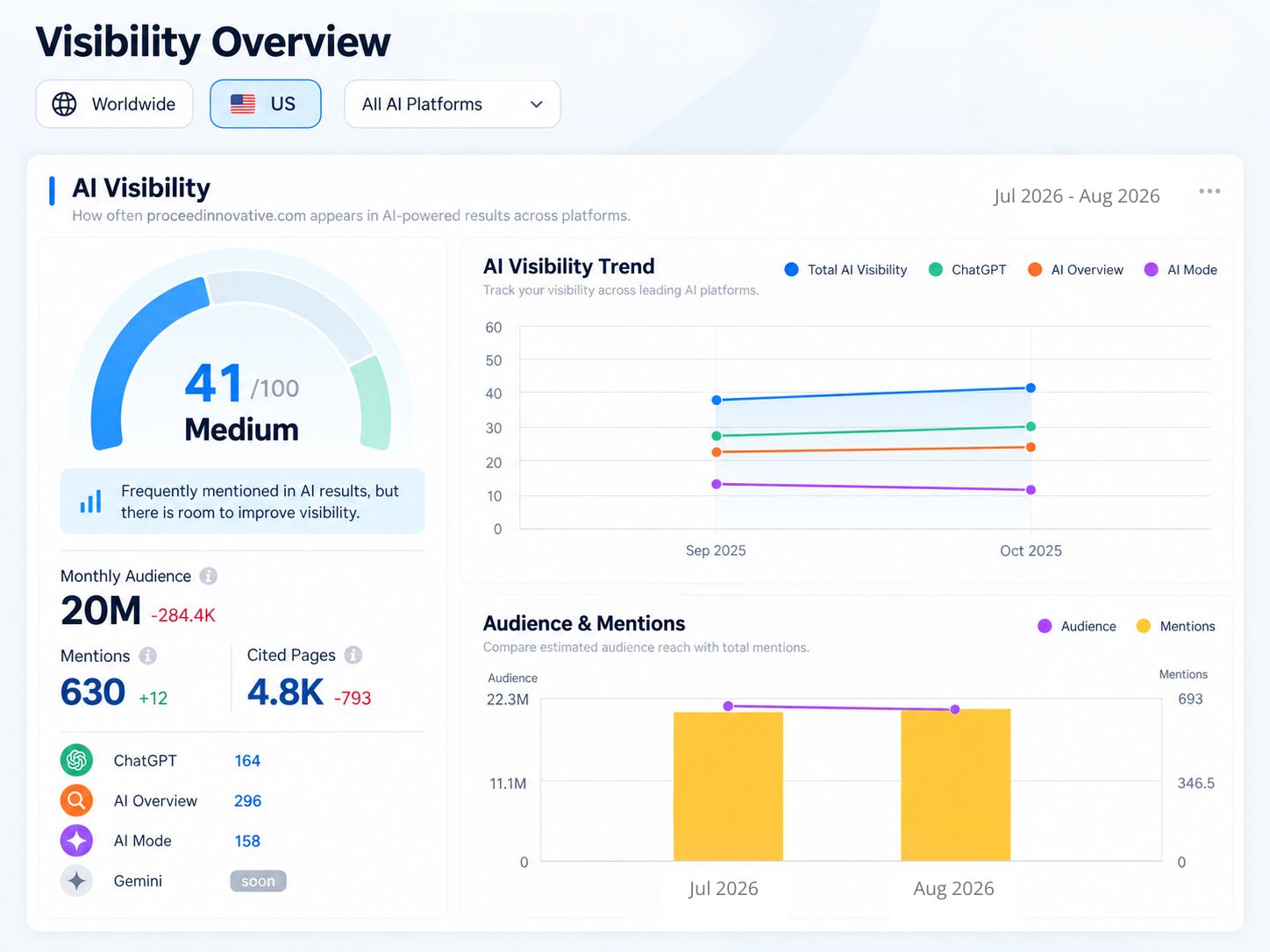
Want to See Your AI Visibility?
Find out how often your company is mentioned in ChatGPT, Google AI Overviews, AI Mode, and other AI search platforms, which pages are being cited, and where you have opportunities to improve your visibility.
Get a Free AI Visibility Audit
What Improves AI Search Visibility?
Here is the work we prioritize, in the order we typically sequence it.
- Fix the machine-readable foundation first: Add schema markup for your organization, services, locations, and FAQs, clean up internal linking, and make sure important content is available in crawlable HTML rather than hidden behind JavaScript. AI systems need to find, interpret, and connect your information before they can cite it. This is the least glamorous work, but it establishes the foundation for everything that follows.
- Rewrite service pages to answer first, then sell: Lead with the direct answer. When an AI system extracts information from a page, clarity matters. If the first 60 words are a mission statement, the useful answer may never make it into the response. Give buyers and AI models the information they came for before the pitch.
- Publish something only you can provide: Project data. Lead-time benchmarks. Cost ranges. Failure rates. Before-and-after results. Original data is one of the strongest citation assets we have seen because competitors cannot simply reproduce it with a prompt.
- Build comparison and alternatives content: If buyers are asking AI to compare your company with three named competitors, someone is going to provide that information. Create useful, factual comparison content that addresses the questions buyers are asking.
- Strengthen your entity signals beyond your website: Keep company descriptions consistent across important third-party profiles. Maintain active review profiles, trade association listings, industry directories, and earned mentions. For companies serving multiple markets, this work overlaps heavily with multi-location SEO.
- Measure what has changed: Track citation appearances by prompt, AI-referred sessions and their conversion rates, branded search volume, and assisted conversions. Traditional rankings still matter. They are simply no longer the only visibility metric worth watching.
What AI Search Means for Chicago-Area B2B Companies
The firms we work with across manufacturing, industrial services, and the trades share a specific vulnerability: much of their expertise still lives in people’s heads and PDF spec sheets rather than on their websites. That was survivable when buyers called for details. It becomes a serious disadvantage when AI models build shortlists from the information they can find, read, and understand online.
The opportunity is that relatively few competitors in these industries have solved this problem yet. We see it most clearly in our SEO services for manufacturing companies and contractor SEO engagements, where a single, well-structured specification page can begin earning citations within weeks. Our SEO case studies show how those individual gains can compound over a longer horizon.
How AI Search Affects B2B Buyer Behavior FAQs
Is AI Search Replacing Google for B2B Research?
No, it is being added to it. G2’s March 2026 data found 51% of B2B buyers now start in an AI tool, which means roughly half still start with traditional search. Most buyers use both, moving between an AI assistant for synthesis and Google for verification. The practical implication is that you need to win in both places, not pick one.
How Do I Know if My Brand Appears in AI Search Results?
Run your highest-intent buying questions through ChatGPT, Gemini, Perplexity, and Google AI Mode, and record which brands get named and which sources get cited. Do it on a fixed schedule so you have a trend line rather than a snapshot. Dedicated tracking tools exist, and we include this monitoring in our AI SEO services.
Does AI SEO Replace Traditional SEO?
It does not. AI systems draw heavily on the same signals that drive organic rankings: crawlability, content quality, authority, and structured data. AI optimization adds a layer focused on extractability, entity clarity, and citation-worthiness. Companies with weak technical SEO fundamentals do not get to skip ahead to the AI layer.
How Long Does It Take to See Results?
Technical and schema fixes can influence AI citation within a few weeks, because models re-crawl frequently. Authority and consistent citation share build over three to six months, similar to organic SEO timelines. Anyone promising AI visibility in ten days is selling something.
Our Organic Traffic Is Down. Is That AI, or Did We Do Something Wrong?
Check the query type before you panic. If informational and top-of-funnel queries are down while commercial and branded queries are stable, that pattern matches the AI Overview effect. If commercial queries are also falling, you likely have a separate problem. A proper diagnosis requires looking at impressions, position, and CTR together rather than sessions alone.
What Should a B2B Marketing Team Do First?
Audit what AI tools currently say about you, fix structured data and page-level answer formatting, and publish one piece of original data. Those three moves cover the majority of the gap for most mid-market B2B companies.
Contact Proceed Innovative for Help with B2B Marketing in Chicagoland
AI search did not break B2B marketing. It moved the decision earlier, accelerated the research process, and shifted more of the shortlisting work to systems that read and interpret your website differently than a human buyer does.
The companies that adapt now can build visibility while their competitors are still figuring out what changed. The ones that wait risk discovering too late that buyers are forming their shortlists somewhere their traditional analytics do not show.
If you want to know where your brand stands today, we will show you. Proceed Innovative is a Schaumburg-based B2B digital marketing agency that has been helping companies get found online since 2008.
Start here:
- Explore our B2B SEO services to see how we connect your brand with decision-makers actively researching solutions like yours.
- Get a free AI visibility audit through our AI SEO services to find out where and whether you appear in ChatGPT, Google AI Overviews, Gemini, and Perplexity today.
About the Author: Yashasvi Rochwani